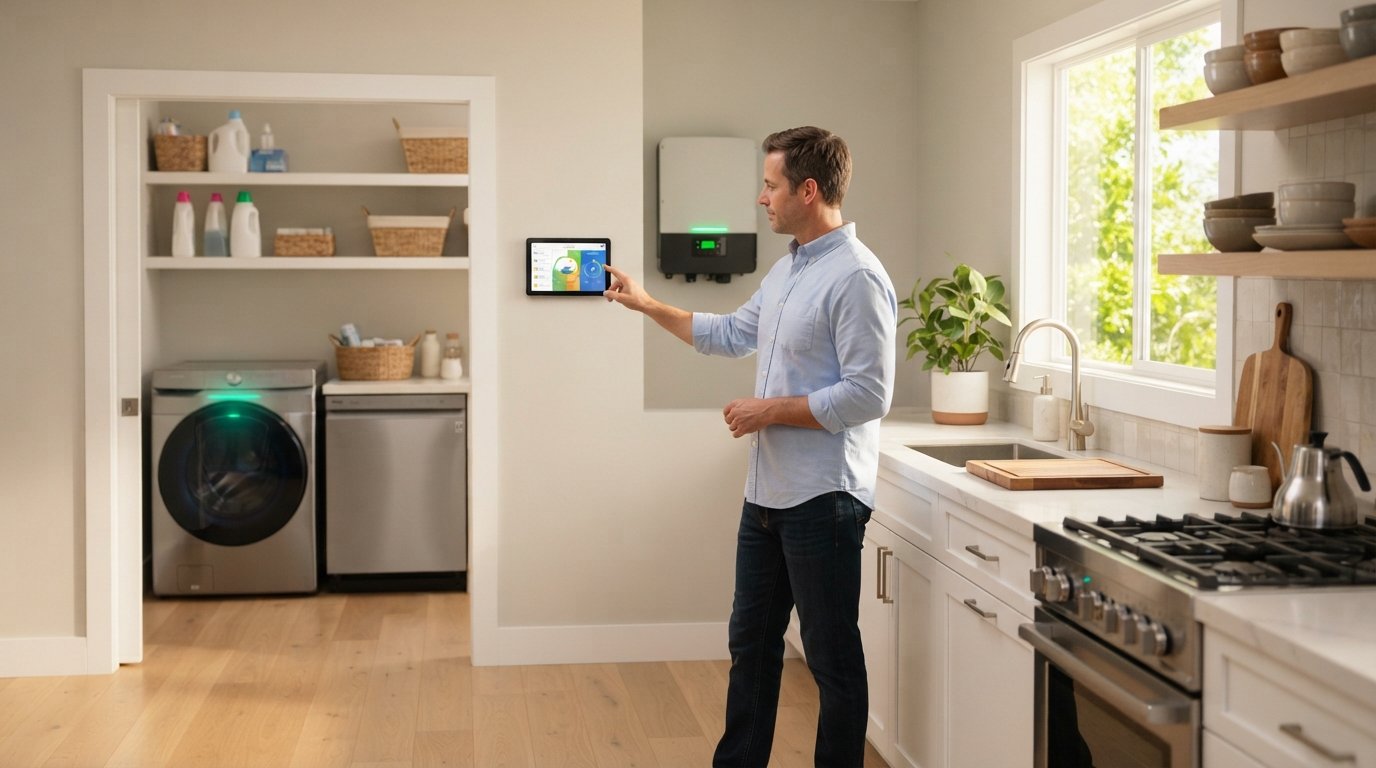
Smart Home Appliances Optimized for Solar Consumption
Smart home appliances optimized for solar consumption can boost self-consumption and cut payback time. Call (833)-434-4023 for expert guidance.

By Owen Phillips
Learn more about Solar Panel Installation and Repair for guides, costs, and what to expect.
Compare Solar Panel Installation and Repair Pros Near You

Enter your ZIP code to compare top-rated local professionals and request free quotes.
Your solar panels generate clean electricity all day, but without the right appliances and timing, much of that production can slip back to the grid for little credit. Smart home appliances optimized for solar consumption turn your home into an active participant in energy management, shifting heavy loads to sunny hours and reducing evening grid draw. For homeowners who want to squeeze every kilowatt-hour from their investment, the combination of efficient appliances and intelligent scheduling is no longer a luxury: it is the difference between a system that pays for itself in six years and one that takes twelve.
The core idea is simple. Solar production peaks around midday, while most homes use the most electricity in the morning and evening. By choosing appliances that can be programmed or remotely controlled, and by pairing them with a smart hub, you can align your biggest energy users with the sun. This guide walks through which appliances benefit most, how to set up the technology, and how to measure your progress. Along the way, we will point out practical tools and services, including ways to connect with vetted solar professionals who can help you design a system that matches your appliance load profile.
Why Solar Self-Consumption Matters More Than Ever
When you send excess solar electricity to the grid, the credit you receive depends on your utility's net metering policy. In many areas, that credit is lower than the retail rate you pay for electricity at night, a difference known as the solar payback gap. Every kilowatt-hour you consume directly from your own panels avoids that gap and delivers the full retail value of the energy. Smart appliances help you capture that value by moving flexible loads into the solar window.
Consider a typical home with a 7 kilowatt solar array. On a sunny day it might produce 35 kilowatt-hours. If the household uses only 12 of those hours on site and exports 23, the financial benefit depends heavily on export rates. But if smart scheduling shifts another 10 kilowatt-hours of consumption (water heating, laundry, vehicle charging) into the daylight hours, the homeowner keeps more of the expensive retail-rate energy and exports less. Over a year, that can add hundreds of dollars in savings without adding a single panel.
The appliances that offer the most flexibility are those with thermal storage or inherent scheduling tolerance: heat pump water heaters, clothes dryers, dishwashers, EV chargers, and even pool pumps. By contrast, refrigerators and lights are less flexible, though efficiency upgrades still reduce overall load. The table below summarizes the load-shifting potential of common home appliances.
- Heat pump water heater: High potential (thermal storage, can be scheduled to heat during peak sun)
- Clothes dryer: High potential (run midday instead of evening)
- EV charger: Very high potential (charge only when solar production exceeds home demand)
- Dishwasher: Moderate potential (delay start to midday)
- Pool pump: High potential (run during sunniest hours)
- Refrigerator/freezer: Low potential (must run continuously, but efficiency upgrades help)
Understanding your own consumption pattern is the first step. Many utilities provide interval data, and a home energy monitor can give real-time feedback. Once you know when you use power, you can decide which appliances to automate.
Top Appliances for Solar-Aligned Scheduling
Not all smart appliances are created equal. The best candidates combine high energy use with the ability to defer operation without inconvenience. Heat pump water heaters, for example, store hot water in a tank, so they can heat water when solar is abundant and coast through cloudy or evening periods. Modern models include built-in timers or connectivity to smart home platforms, allowing you to set a schedule that prioritizes midday heating.
Clothes dryers are another strong candidate. A typical electric dryer uses 3 to 4 kilowatt-hours per load. If you run three loads per week in the evening, shifting them to Saturday and Sunday midday (or weekday mornings if someone is home) can soak up surplus solar. Many newer dryers offer delay start or app control. Similarly, dishwashers can be set to run on a delay, and pool pumps can be programmed to operate during the sunniest six hours of the day.
EV chargers represent the largest flexible load in many homes. A Level 2 charger can draw 7 to 11 kilowatts, which may exceed solar production on cloudy days but can be modulated on sunny days. Smart chargers can communicate with your solar system or a home energy management hub to charge only when production exceeds household demand, a technique called solar tracking. If you are considering an EV, plan your solar system size accordingly: adding 10 kilowatt-hours per day of driving requires roughly 2.5 kilowatts of additional solar capacity in a sunny climate. Tools like a solar savings calculator can help you estimate the impact.
When selecting appliances, look for ENERGY STAR certification and check the yellow EnergyGuide label for annual consumption. Higher efficiency reduces overall load, which may allow a smaller solar system and lower upfront cost. But efficiency alone is not enough: a highly efficient dryer that runs at 8 PM still pulls from the grid. The winning strategy combines efficiency with smart scheduling.
Smart Plugs, Hubs, and Routines: The Control Layer
To align appliances with solar production, you need a control layer: smart plugs, relays, or built-in Wi-Fi in the appliances themselves. Smart plugs are the simplest entry point. Plug your dryer or dishwasher into a smart plug (rated for the load) and create a schedule or automation that turns it on when solar production is high. However, most smart plugs are not designed for high-power appliances like dryers; check ratings carefully. For hardwired loads like water heaters, use a smart relay or a dedicated energy management system.
A smart home hub (such as Home Assistant, SmartThings, or Apple Home) can tie everything together. The most effective routines use data from your solar inverter or a home energy monitor. For example, a routine might say: if solar production exceeds 3 kilowatts and the water heater temperature is below setpoint, turn on the water heater. Or: if the EV is plugged in and solar production is above 5 kilowatts, start charging at a reduced rate. Many utilities and solar monitoring platforms offer APIs that can feed data into these hubs. For a deeper dive into AI-driven optimization, see our guide on optimizing solar energy with AI for maximum home savings.
If programming your own routines sounds daunting, professional services can help. SolarEnergy.ai offers energy surveys that identify load-shifting opportunities and can recommend compatible devices. Their team can also install emergency lighting and electrical security upgrades, which can be integrated into your smart home ecosystem. When you are ready to design a solar system that accommodates your appliance plans, reaching out to local experts is a smart move.
Efficiency Ratings and Solar Sizing: The Hidden Connection
Appliance efficiency directly affects the size of the solar system you need. A home with an old refrigerator, incandescent lighting, and a conventional electric water heater may require a 10 kilowatt array to meet its needs. Upgrading to ENERGY STAR appliances and a heat pump water heater could cut that requirement to 7 kilowatts, saving thousands in installation costs. The savings compound: a smaller system means lower equipment costs, less roof space, and often a faster payback.
When planning a solar installation, ask your installer to perform a load audit. Many companies, including the professionals you can find through SolarEnergy.ai, offer this as part of their energy survey. They will look at your major appliances, their run times, and your lifestyle to recommend a system size that maximizes self-consumption. If you are also planning a move, resources like Moving.Homes provide checklists and guides that can help you coordinate a solar-ready home purchase or transfer an existing system.
It is also worth considering the interactive effect between efficiency and scheduling. A heat pump water heater, for instance, uses roughly half the energy of a resistance model. That means you can meet your hot water needs with a smaller solar array, and the scheduling flexibility remains. Similarly, a heat pump dryer uses less energy per load, so shifting it to solar hours yields a greater proportion of self-consumption. Always verify incentive details, as federal tax credits and local rebates change; consult the incentives and rebates guide for current information.
Measuring Your Self-Consumption Improvement
You cannot manage what you do not measure. Most solar inverters come with monitoring apps that show production, consumption, and export. To assess the impact of smart appliance scheduling, establish a baseline: track your self-consumption ratio (the percentage of solar production consumed on site) for a month before making changes. Then implement your scheduling routines and compare.
A home energy monitor with circuit-level tracking (like Sense or Emporia) provides more granular data, showing exactly when each appliance runs. With this data, you can calculate the solar coverage of each load: for example, what percentage of your water heater's energy came from solar. Aim to increase that percentage over time. Many utilities also provide hourly data through smart meters, which can be exported to a spreadsheet for analysis.
Set realistic goals. A typical home without any load shifting might self-consume 30 to 40 percent of solar production. With smart scheduling of flexible loads, that can rise to 60 or 70 percent. The exact figure depends on your battery storage (if any), your utility's export rates, and your lifestyle. If you have a battery, the control system can store surplus solar for evening use, further boosting self-consumption. But batteries add cost, so maximizing direct consumption first is usually the most cost-effective step.
Finally, consider the role of professional monitoring and optimization services. Some solar companies offer ongoing analysis and adjust settings remotely to improve performance. SolarEnergy.ai's platform includes tools and resources to help you track savings and understand your system's output. If you prefer a hands-off approach, ask your installer about managed energy services.
Smart home appliances optimized for solar consumption are a powerful way to get more value from your solar investment. By choosing the right appliances, setting up intelligent controls, and measuring your results, you can significantly increase self-consumption and reduce payback time. Start with a load audit, prioritize the biggest flexible loads, and build routines that automate the process. With a little planning, your home can run on sunshine for more hours of the day.