Perovskite Solar Panels: Residential Availability in 2026
Perovskite solar panels residential availability 2026 is limited to pilot programs, but tandem cells promise higher efficiency. Call (833)-434-4023 for expert guidance.

By Mason Carter
Learn more about Solar Panel Installation and Repair for guides, costs, and what to expect.
Compare Solar Panel Installation and Repair Pros Near You

Enter your ZIP code to compare top-rated local professionals and request free quotes.
Imagine a solar panel that costs less, weighs less, and produces more electricity than anything on your roof today. That is the promise of perovskite solar cells, a technology that has moved from laboratory curiosity to pilot production lines in less than a decade. As a homeowner in the United States, you may be wondering whether you can actually buy perovskite solar panels for your house in 2026, or if this is still a story about the future. The short answer is nuanced: perovskite technology is real, it is being manufactured, and it is starting to appear in niche residential products, but it is not yet a mainstream, warranty-backed option for every rooftop. This article breaks down what perovskite and tandem cells are, why efficiency records keep falling, what unresolved durability questions mean for homeowners, which manufacturers are piloting products, and how you can future-proof a solar purchase while waiting for the technology to mature.
What Perovskite Solar Cells Are and Why Efficiency Records Keep Rising
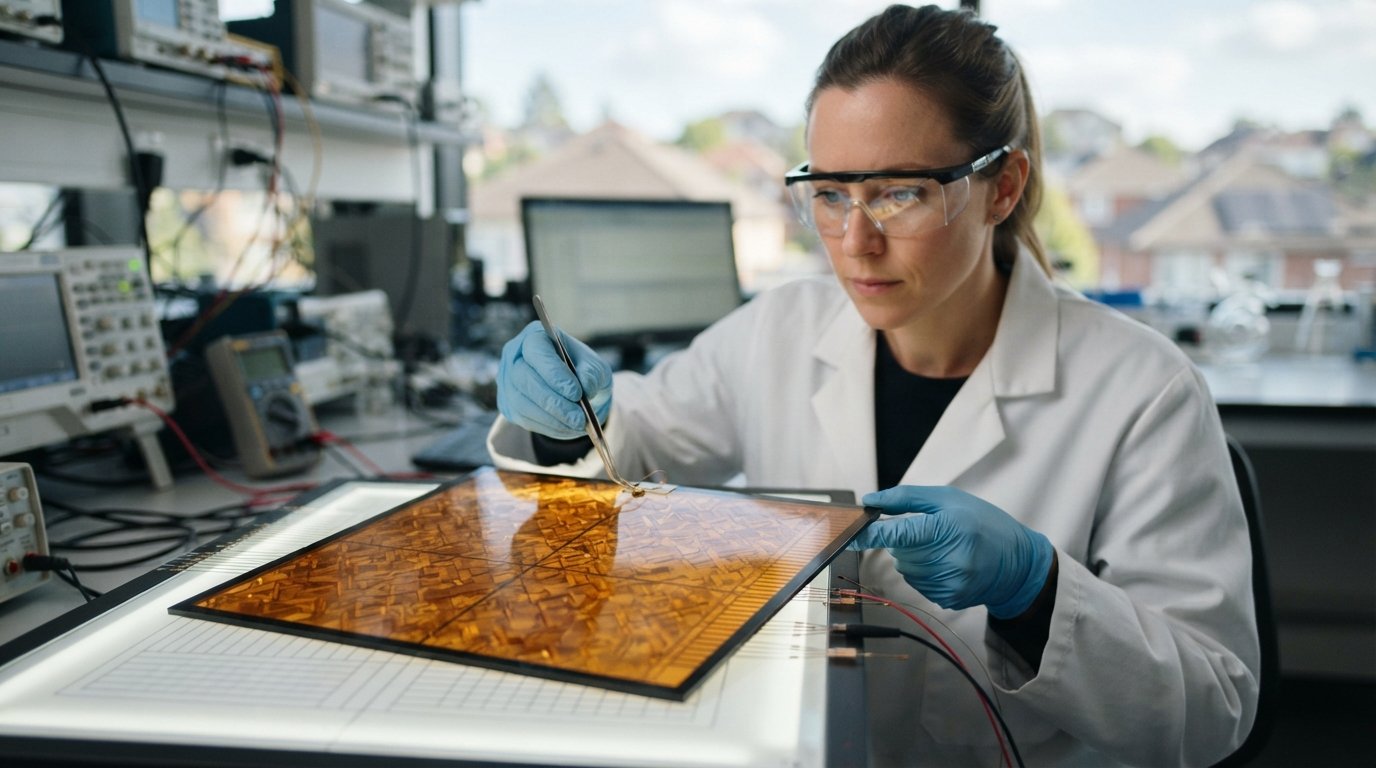
Perovskite refers to a class of materials with a specific crystal structure, typically made from organic and inorganic compounds such as methylammonium lead iodide. Unlike silicon, which requires high temperatures and energy-intensive purification, perovskite films can be deposited at low temperatures using solution-based methods like spin coating or inkjet printing. This makes them potentially far cheaper to produce and allows them to be applied to flexible substrates, including plastic and glass. The efficiency of perovskite solar cells has climbed from around 3.8 percent in 2009 to over 26 percent for single-junction cells in laboratory settings, and tandem configurations that stack perovskite on top of silicon have exceeded 33 percent. These records keep rising because researchers have learned to tune the bandgap of perovskite materials, passivate defects at grain boundaries, and improve charge transport layers. For homeowners, higher efficiency means more power per square foot, which matters if you have limited roof space. But laboratory records do not automatically translate into products that can survive 25 years on your roof, and that gap is the central issue for residential availability in 2026.
Tandem cells are particularly attractive for residential use because they can be integrated with existing silicon manufacturing lines. A perovskite top cell absorbs high-energy photons that silicon largely wastes as heat, while the silicon bottom cell absorbs the rest. This boosts overall output without requiring a completely new factory. Companies like Oxford PV in the United Kingdom and several Chinese manufacturers have announced tandem products for utility and commercial markets, with residential versions on the roadmap. However, the residential market demands more than efficiency: it demands proven reliability, standardized warranties, and certification under building codes. Those requirements are why perovskite solar panels are not yet sitting on Home Depot shelves in 2026.
Stability, Durability, and Warranty Questions Still Unresolved for Rooftops
The biggest barrier to residential perovskite availability in 2026 is not efficiency but stability. Perovskite materials are sensitive to moisture, oxygen, heat, and ultraviolet light. They can degrade rapidly if not encapsulated properly, and even with advanced encapsulation, field data over 25 years is nonexistent because the technology is too new. Silicon panels come with 25- to 30-year warranties because manufacturers have decades of field data showing predictable degradation of about 0.5 percent per year. Perovskite panels currently have no such track record. Some manufacturers offer 10- to 15-year warranties on early commercial products, but those are not yet widely available for residential rooftops. Homeowners should be cautious about any perovskite product that promises a 25-year warranty without third-party certification and real-world field data.
Another unresolved issue is lead content. Many high-efficiency perovskites contain lead, which raises environmental and health concerns if panels break or degrade. Researchers are developing lead-free perovskites and robust encapsulation to prevent leakage, but regulations for residential deployment are still evolving. The National Renewable Energy Laboratory and other testing bodies are working on accelerated lifetime tests, but these cannot fully replicate 25 years of temperature cycling, humidity, and mechanical stress. For a homeowner, this means that perovskite solar panels residential availability in 2026 is limited to early-adopter products with shorter warranties and higher uncertainty. If you are risk-averse, waiting for more field data is prudent. If you are an early adopter, you should budget for potential replacement and verify that your installer has experience with emerging technologies.
Which Manufacturers Are Piloting Perovskite Products for Residential Use
Several companies are actively piloting perovskite and tandem products, though most are targeting utility-scale or commercial markets first. Oxford PV has produced tandem modules and is working with partners to scale manufacturing. In the United States, companies like Swift Solar and CubicPV are developing perovskite tandem technology, with some pilot lines expected to produce residential-compatible modules in the 2026-2027 timeframe. Chinese manufacturers such as LONGi, Trina Solar, and GCL Perovskite have announced large-scale perovskite production plans, but their initial focus is on utility and commercial installations. For residential availability in 2026, the most likely scenario is that a limited number of specialty installers will offer perovskite or tandem panels as a premium option, often paired with battery storage and smart monitoring systems.
It is important to distinguish between pilot production and mass-market availability. A pilot line might produce a few megawatts of panels per year, enough for a few hundred homes, not millions. These panels may be offered through select installers in California, Texas, or New York, where incentives and grid policies favor early adoption. If you are interested in being an early adopter, you should ask installers about product certification (UL 61730, IEC 61215), warranty terms, and whether the manufacturer has field data from pilot installations. You should also check with your local building department to ensure perovskite panels meet fire and structural codes. For most homeowners, however, the practical choice in 2026 is still high-efficiency silicon or silicon-perovskite tandem panels from established manufacturers with proven warranties.
How to Future-Fix a Solar Purchase While Waiting for Perovskite Maturity
If you are planning a solar installation in 2026 but want to keep the door open for perovskite upgrades later, you can take several steps to future-proof your system. First, size your inverter and wiring for a higher-capacity future array. Many modern inverters and rapid shutdown devices can handle a 20-30 percent oversizing of DC capacity, which means you could add more powerful panels later without replacing the balance of system. Second, choose a mounting system with adjustable rails or extra attachment points so that panels can be swapped or added without a full re-roof. Third, consider a battery-ready electrical panel and a hybrid inverter that can accommodate both solar and storage. Fourth, document your roof age and structural capacity; if your roof is nearing the end of its life, replace it before installing solar so that you are not paying for removal and reinstallation when perovskite panels become available.
Another strategy is to lease or finance your system with a shorter term, or to choose a modular design that allows incremental expansion. If you own your solar system outright, you can plan to replace panels in 10-15 years when perovskite technology is more mature, rather than waiting 25 years. To estimate how many panels you need now and how much roof space to reserve for future upgrades, you can use our guide on how to figure how many solar panels you need. That guide helps you calculate your energy consumption, roof area, and system size, which is essential for planning a phased approach. Finally, work with a qualified installer who understands emerging technologies and can advise on compatibility. If you need help finding a pre-vetted local contractor for solar installation or related home improvement projects, you can use a platform like Contractor.Homes to request free quotes and compare options. This is especially useful if you want to ensure your roof and electrical panel are ready for future upgrades.
Realistic Timeline for Perovskite Panels Reaching US Homeowners
Based on current pilot production schedules and certification timelines, a realistic timeline for perovskite solar panels residential availability in 2026 is as follows: in 2026, limited availability through specialty installers, primarily in states with strong solar incentives and progressive building codes. These early products will likely be tandem modules with 10- to 15-year warranties and higher price points per watt than mainstream silicon. By 2027-2028, expect broader availability as more manufacturers complete certification and field testing, with warranties extending to 20 years. By 2030, perovskite and tandem panels could become a mainstream option for residential rooftops, with competitive pricing and standard 25-year warranties, provided that stability and lead-content issues are fully resolved. This timeline assumes continued investment in manufacturing scale-up and favorable regulatory treatment. It could accelerate if a major manufacturer achieves a breakthrough in encapsulation or lead-free perovskites, or slow down if field failures erode confidence.
For homeowners, the key takeaway is that perovskite solar panels are not yet a plug-and-play replacement for silicon in 2026, but they are close enough that you should consider future compatibility when designing your system. If you are building a new home or replacing a roof, you might choose a mounting system and inverter that can accommodate higher-efficiency panels later. If you are installing solar now, you can still benefit from generous federal tax credits and state incentives, and you can plan to upgrade in a decade. To explore current incentives and calculate savings, use our solar savings calculator and incentives guide. And if you want to connect with local solar pros who can advise on both current and future technology, find solar installers through our network. The transition to perovskite is coming, and with thoughtful planning, your home can be ready to take advantage of it.