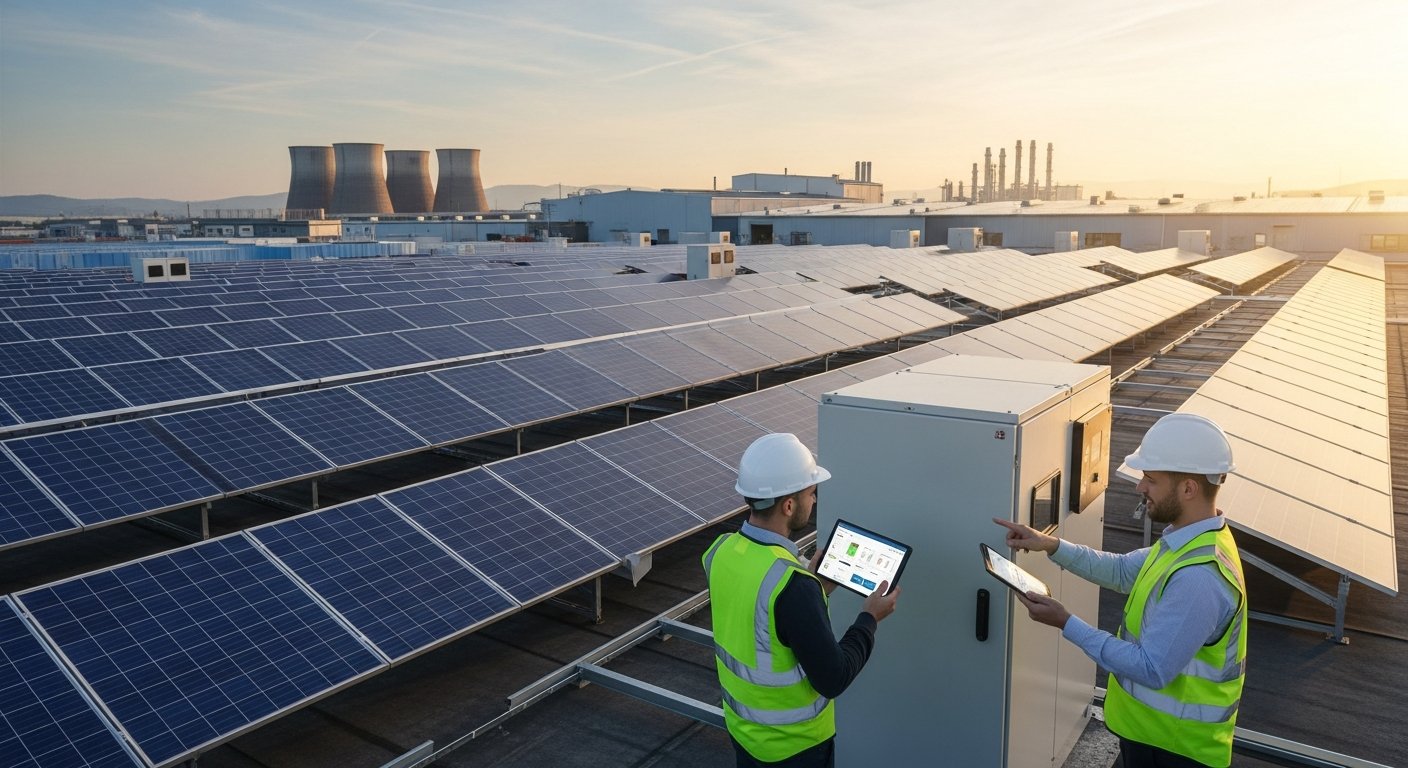
Industrial Solar Panels: A 2026 Buyer's Guide
Explore how industrial solar panels cut energy costs for large facilities, with 2026 incentives, sizing tips, and maintenance best practices.

By Owen Phillips
Learn more about Solar Panel Installation and Repair for guides, costs, and what to expect.
Compare Solar Panel Installation and Repair Pros Near You

Enter your ZIP code to compare top-rated local professionals and request free quotes.
Industrial solar panels are no longer a niche investment for eco-conscious corporations. They have become a core financial strategy for manufacturers, warehouses, cold storage facilities, and large-scale agricultural operations. If your facility consumes 100,000 kilowatt-hours or more each year, the difference between a standard commercial installation and a true industrial-grade system can mean hundreds of thousands of dollars in lifetime savings. This guide explains what makes industrial solar panels distinct, how to evaluate them, and what the full deployment process looks like in 2026.
What Are Industrial Solar Panels?
Industrial solar panels are high-capacity photovoltaic modules designed for large-scale energy generation. Unlike residential panels, which typically range from 300 to 400 watts, industrial modules often exceed 500 watts per panel. They are built with sturdier frames, thicker glass, and advanced cell architectures that maximize efficiency in tight spaces, such as factory rooftops or ground-mounted arrays.
The key difference is not just physical size but the system architecture. Industrial systems integrate with high-voltage inverters, three-phase electrical infrastructure, and advanced monitoring platforms. They also require more robust racking and ballast systems to handle wind loads and thermal expansion. For a facility manager, this means the entire electrical layout must be reviewed, not just the roof space.
When we talk about industrial solar, we are also talking about scale. A typical industrial installation ranges from 250 kilowatts to several megawatts. That is enough to offset a significant portion of a factory's daytime load, and in many cases, it can cover 80 to 100 percent of annual consumption with the right battery storage configuration.
Top Benefits for Large-Scale Operations
Before committing to a capital project, decision-makers need clarity on the return. The benefits of industrial solar panels extend beyond the obvious utility bill reduction:
- Hedging against volatile electricity rates: Industrial tariffs often include demand charges and time-of-use rates. Generating your own power during peak hours reduces both energy and demand charges.
- Federal Investment Tax Credit (ITC): The 30% tax credit is available for systems placed in service through 2032, with a step down to 26% in 2033. This directly reduces your net system cost.
- Accelerated depreciation: The Modified Accelerated Cost Recovery System (MACRS) allows you to depreciate the system over five years, which can significantly lower your tax liability in the first few years of operation.
- Environmental, Social, and Governance (ESG) goals: Corporate sustainability targets are increasingly tied to supply chain contracts. A verifiable solar installation strengthens your position with eco-conscious clients.
These benefits compound. For example, a 1-megawatt system in Texas that produces 1.6 million kilowatt-hours annually can save over $200,000 per year at current commercial rates. With incentives, the payback period can shrink to under four years.
However, the financial case is not automatic. It depends heavily on your local utility's net metering policy, your load profile, and the physical condition of your roof or land. That is why a professional energy survey is a non-negotiable first step.
Key Components of an Industrial Solar System
Understanding the components helps you ask better questions when evaluating proposals. Each part has a specific role in system performance and longevity.
High-Efficiency Photovoltaic Modules
Industrial panels use either monocrystalline PERC (Passivated Emitter and Rear Cell) or TOPCon (Tunnel Oxide Passivated Contact) technology. TOPCon modules, which became mainstream in 2025, offer efficiencies above 22% and better performance in low-light conditions. Bifacial models, which capture light on both sides, are also common for ground-mounted systems with reflective surfaces.
When comparing panels, look beyond the wattage. Check the temperature coefficient, which indicates how much power drops as the panel heats up. A lower coefficient, around -0.30% per degree Celsius, is better for hot climates.
Inverters and Power Conversion
Central inverters handle high voltage and are cost-effective for systems above 500 kilowatts. String inverters are simpler and allow for easier maintenance, while microinverters are rarely used at the industrial scale due to cost. In 2026, most industrial systems use either central inverters with DC optimizers or hybrid inverters that support battery integration.
Your choice depends on shading, roof orientation, and future expansion plans. A professional installer can model the production losses for each option.
Mounting and Racking Systems
Racking must withstand wind uplift, snow load, and seismic activity. Ballasted systems are common for flat commercial roofs, while ground mounts use driven piles or helical anchors. The racking choice affects installation speed and overall system weight, which is critical for older buildings.
If your roof needs replacement in the next 10 years, address that before installing solar. Otherwise, you will pay to uninstall and reinstall the system.
How to Size and Design an Industrial Solar Array
Sizing is not about matching your annual consumption. It is about optimizing the system against your utility rate structure and physical constraints. Here is a practical approach:
- Review 12 months of utility bills: Identify your peak demand, monthly consumption, and time-of-use rates. This data drives the system size and whether battery storage is justified.
- Conduct a structural assessment: A licensed engineer must verify the roof or ground conditions. This includes checking the age of the roof, load-bearing capacity, and any warranties that might be voided by penetrations.
- Perform a solar site analysis: Use aerial imagery and on-site shading analysis to determine the optimal tilt, orientation, and layout. Obstructions like HVAC units and parapets can reduce usable area.
- Select the system size: The goal is to maximize the net present value, not just the number of panels. Sometimes a smaller system with fewer obstructions yields a better return.
- Model the financial return: Use tools like SolarEnergy.ai's savings calculator to estimate cash flow over 25 years, including degradation and inflation.
This process is iterative. You may need to adjust the system size based on budget constraints or incentive caps. A good engineering partner will provide multiple scenarios, not a single quote.
Financial Incentives and Payback Periods
The financial landscape for industrial solar in 2026 is favorable but complex. The federal ITC remains at 30% for projects that start construction before 2033. Many states offer additional rebates or performance-based incentives. For example, California's Self-Generation Incentive Program (SGIP) supports battery storage, while New York's NY-Sun program provides per-watt incentives for commercial systems.
Beyond the ITC, accelerated depreciation is a powerful tool. Under MACRS, you can deduct 85% of the system's depreciable basis in the first five years (after factoring in the half-year convention). This is especially valuable for profitable corporations.
Payback periods for industrial systems typically range from 3 to 7 years, depending on your location and electricity rates. After that, the system produces near-free electricity for the remaining 20 to 25 years of its useful life. The internal rate of return often exceeds 15%, which is higher than many corporate capital projects.
One caution: incentives can change. Always verify the latest rules with the Database of State Incentives for Renewables & Efficiency (DSIRE) or a qualified tax advisor.
Installation and Maintenance Best Practices
Installation of an industrial solar system is a major project. It involves permits, utility interconnection agreements, and often a crane for lifting panels. The average timeline is 8 to 16 weeks from contract to commissioning.
Choose an installer with verifiable experience in industrial projects. Ask for references, inspect their past work, and confirm they hold the appropriate licenses and insurance. A poor installation can lead to roof leaks, electrical faults, and reduced production.
Once operational, maintenance is relatively low but not zero. Here are the essential tasks:
- Quarterly visual inspections: Look for cracks, delamination, or soiling that could affect performance.
- Annual cleaning: Depending on your location, dust, bird droppings, and pollen can reduce output by 5 to 10%. In dry climates, more frequent cleaning may be needed.
- Monitoring: Use a platform like SolarEnergy.ai's monitoring service to track production in real time. Set alerts for unusual drops in output.
- Inverter maintenance: Inverters have a shorter lifespan than panels (10 to 15 years). Budget for replacement.
Good maintenance not only protects your investment but also ensures the system operates at peak efficiency for decades.
Battery Storage and the Future of Industrial Solar
The integration of battery storage is transforming industrial solar. With storage, you can shift solar production to evening hours, avoid demand spikes, and even participate in grid services like demand response. In 2026, the cost of lithium-ion battery packs has fallen to around $150 per kilowatt-hour, making storage economically viable for many industrial sites.
For example, a facility with a 500-kilowatt solar array and a 1-megawatt-hour battery can capture excess midday energy and discharge it during the 4 to 9 p.m. peak window, when rates are highest. This can reduce electricity costs by an additional 15 to 30%.
Looking ahead, industrial solar will evolve with advances in AI-based energy management. Our article on AI powered solar panels explains how machine learning can predict production and optimize consumption automatically. Similarly, if you are considering an upgrade, our guide on adding solar panels covers the integration process. And for facilities that face frequent outages, emergency solar panels can provide critical backup power.
Industrial solar panels are a proven technology with a compelling financial case. By understanding the components, sizing, incentives, and maintenance, you can confidently move forward. The key is to work with experienced partners and use data-driven tools to validate every decision. Start with a professional energy survey and a detailed financial model. Then, when the numbers make sense, you can move to implementation, knowing that your investment will deliver reliable, clean power for decades.
Learn more about Solar Panel Installation and Repair for guides, costs, and what to expect.
Compare Solar Panel Installation and Repair Pros Near You
Enter your ZIP code to compare top-rated local professionals and request free quotes.