Hydrogen Storage for Residential Solar: Future Outlook
Hydrogen storage for residential solar future outlook explores how hydrogen could extend backup power beyond batteries. Call (833)-434-4023 for expert solar guidance.

By Owen Phillips
Learn more about Solar Panel Installation and Repair for guides, costs, and what to expect.
Compare Solar Panel Installation and Repair Pros Near You

Enter your ZIP code to compare top-rated local professionals and request free quotes.
When you install solar panels on your roof, you are capturing free electrons from sunlight, but those electrons only flow while the sun shines. Batteries store some of that energy for nighttime, yet most homeowners still rely on the grid for long stretches of cloudy weather or seasonal dips. Hydrogen storage for residential solar has emerged as a potential game changer, promising weeks of backup power rather than hours. The future outlook is promising but nuanced: hydrogen will not replace lithium batteries soon, but it may become a valuable complement for specific households and microgrids. This article explores how residential hydrogen storage would work, the current limitations, pilot projects, and what homeowners should plan for today versus years ahead.
How Residential Hydrogen Storage Would Work Alongside Solar and Batteries
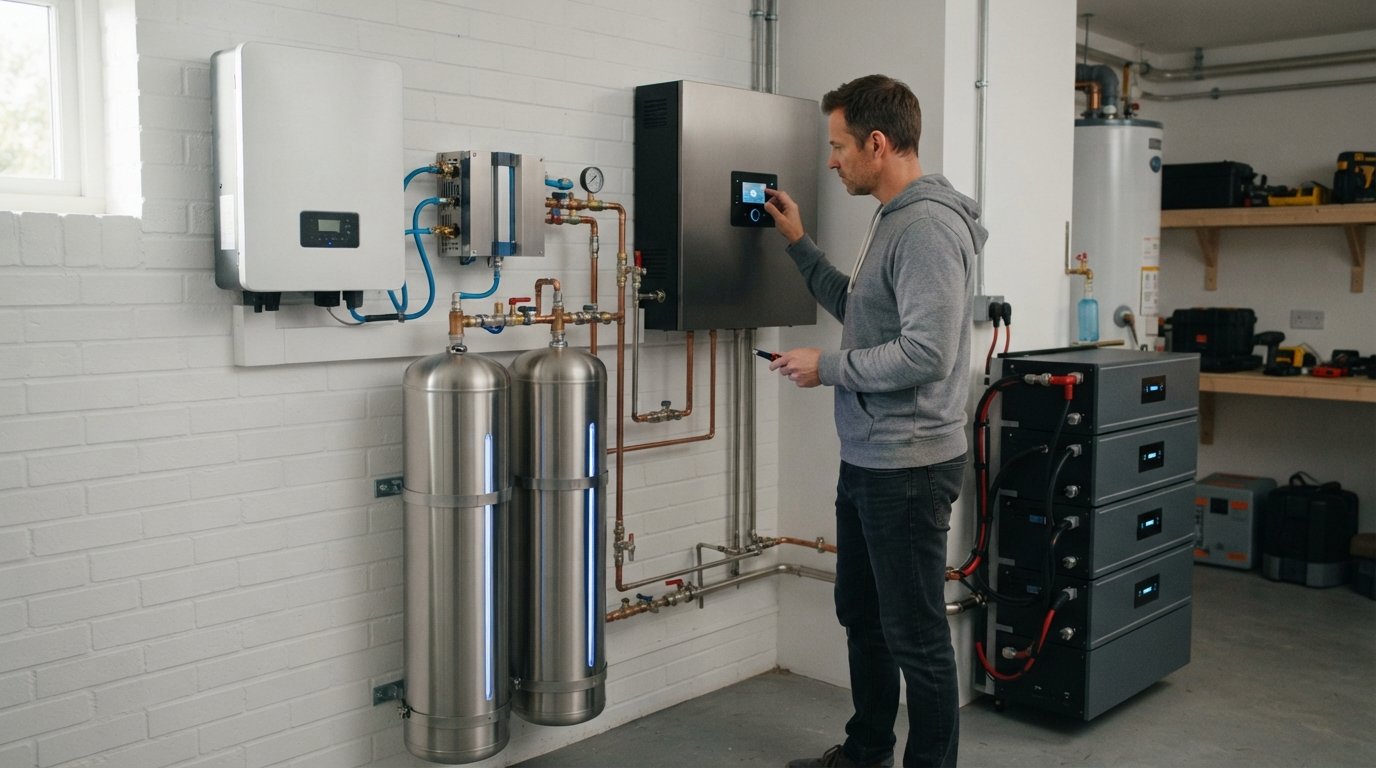
At its core, a residential hydrogen storage system uses surplus solar electricity to power an electrolyzer, which splits water into hydrogen and oxygen. The hydrogen is compressed and stored in tanks, then converted back to electricity via a fuel cell when solar production is low. This creates a closed loop that can store energy for days, weeks, or even seasons, far exceeding the typical 8 to 12 hours of a lithium-ion battery. In a practical setup, your solar array would first charge a small battery for daily cycling, and any excess energy would go to the electrolyzer. The battery handles short-term peaks and overnight loads, while the hydrogen system acts as a long-duration reservoir.
This hybrid approach offers several advantages. A battery responds instantly to changes in load, while hydrogen excels at storing large quantities of energy over time. For example, a homeowner in a cloudy climate could generate excess power in summer, store it as hydrogen, and use it in winter when solar output drops. The system would also include a small buffer battery to manage transient loads and keep the fuel cell from cycling on and off frequently. This division of labor means each technology does what it does best, and the overall system can achieve higher reliability than either alone.
However, the complexity of integrating an electrolyzer, storage tanks, and a fuel cell into a home is significant. You need space for the equipment, proper ventilation, and safety systems to handle hydrogen, which is flammable and leaks easily. The round-trip efficiency (electricity to hydrogen to electricity) is currently around 30 to 40 percent, meaning you lose more than half the energy in the process. By contrast, lithium batteries achieve round-trip efficiencies of 85 to 95 percent. This efficiency gap is the primary reason why hydrogen storage for residential solar is not yet mainstream. Still, for long-duration storage, the efficiency penalty may be acceptable because the alternative is either oversizing a battery bank or relying on the grid.
Current Efficiency and Cost Limitations Compared with Lithium Batteries
The efficiency and cost hurdles are the most frequently cited barriers to residential hydrogen adoption. As mentioned, round-trip efficiency for small-scale hydrogen systems lags far behind lithium batteries. That means you need more solar panels to achieve the same usable energy, which increases the upfront cost. Additionally, the electrolyzer, fuel cell, and storage tanks are expensive at small scales. A typical residential lithium battery costs around $1,000 to $1,500 per kilowatt-hour installed, while a hydrogen system could cost several times that per kilowatt-hour of storage capacity, though it scales better for larger capacities.
To put this in perspective, here are the key limitations of current residential hydrogen storage compared with lithium batteries:
- Round-trip efficiency: 30 to 40 percent for hydrogen versus 85 to 95 percent for lithium.
- Upfront cost: Hydrogen systems are significantly more expensive per kWh at small scales due to low production volumes.
- Space and safety: Requires tanks, ventilation, and safety controls, which are unnecessary for sealed lithium batteries.
- Maintenance: More moving parts (compressors, pumps) and periodic inspections for leaks.
- Technology maturity: Residential hydrogen is still in pilot stages, while lithium batteries are a mature, widely available product.
Despite these drawbacks, hydrogen storage has one critical advantage: the cost per kWh of storage capacity drops dramatically as storage duration increases. For a homeowner who needs only a few hours of backup, lithium is the clear winner. But for a community microgrid or a commercial building that needs days of autonomy, hydrogen becomes more competitive. This is why early deployments are focused on larger scales where the economics work. For residential solar, the future outlook depends on reducing the cost of small-scale electrolyzers and fuel cells, which is an active area of research and development.
Pilot Projects and Regulatory Status in the US Market
Several pilot projects in the United States are testing the viability of hydrogen storage for residential and community applications. For instance, utilities in California and Hawaii have launched demonstrations that pair solar with hydrogen storage to support grid resilience during wildfire season or to reduce reliance on imported fuel. These projects typically involve a cluster of homes or a small microgrid rather than single-family residences, because shared infrastructure reduces costs. The regulatory landscape is still evolving: codes and standards for residential hydrogen storage are being developed by organizations like the National Fire Protection Association (NFPA) and the International Code Council (ICC). Currently, most jurisdictions lack specific permitting pathways for home hydrogen systems, which adds uncertainty for early adopters.
At the federal level, the Department of Energy's Hydrogen Shot initiative aims to reduce the cost of clean hydrogen by 80 percent to $1 per kilogram in a decade. While much of this focus is on industrial and transportation uses, the spillover benefits for residential storage are expected. Some states offer incentives for energy storage that could eventually include hydrogen, but today most rebates and tax credits are designed around batteries. Homeowners interested in hydrogen should monitor their state's public utility commission filings and building codes, as these will determine when and how residential systems can be legally installed.
In the meantime, if you are considering solar plus storage, the most reliable path is to work with vetted solar pros who understand current battery technology and can design a system that is hydrogen-ready. For example, our guide on residential solar in Georgia explains how to size a system and choose equipment that can be upgraded later. This approach ensures you get the benefits of solar today without betting on unproven technology.
Where Hydrogen May Fit First: Commercial and Microgrid Applications
Before hydrogen storage becomes common in single-family homes, it will likely gain traction in commercial buildings, campuses, and microgrids. These settings offer the scale needed to justify the cost of electrolyzers and storage tanks. A commercial building with a large solar array can produce excess hydrogen during weekends or low-demand periods and use it during peak demand to reduce utility demand charges. Similarly, a microgrid serving a neighborhood or a remote community can use hydrogen for seasonal storage, ensuring power during extended outages when batteries would be depleted.
Another early adopter category is emergency preparedness facilities, such as fire stations, hospitals, and community centers. These buildings require reliable backup power for days, and hydrogen storage can provide that without the need for diesel generators. As the technology matures and costs decline, the lessons learned from these commercial and microgrid projects will inform residential products. For homeowners, this means that the hydrogen storage for residential solar future outlook is closely tied to progress in the commercial sector: as economies of scale drive down component costs, residential systems will become more affordable.
It is also worth noting that hydrogen can be integrated with existing natural gas infrastructure in some cases, though this is more relevant for heating than electricity storage. For electricity, the key is to have a dedicated storage system that can be scaled from commercial to residential as technology improves. Companies are already developing compact electrolyzers and fuel cells for home use, but they are not yet widely available. The next five to ten years will be critical for proving reliability and reducing costs.
What Homeowners Should Plan for Today vs Years Ahead
If you are a homeowner considering solar and storage, the most prudent approach is to install a solar array and a lithium battery now, while designing the system to accommodate hydrogen storage in the future. This means ensuring your electrical panel has spare capacity, leaving physical space for future equipment, and choosing an inverter that can be paired with additional storage later. Many solar installers already offer "storage-ready" packages that include the wiring and mounting hardware for future expansion. By planning ahead, you can avoid costly retrofits when hydrogen technology becomes available.
Here are practical steps you can take today to prepare for a hydrogen-powered future:
- Maximize solar production: Install as much solar capacity as your roof and budget allow, since hydrogen storage makes excess generation more valuable.
- Choose a modular battery: Select a lithium battery system that can be expanded or integrated with other storage types later.
- Upgrade your electrical panel: Ensure your panel can handle future storage and EV charging loads.
- Document your energy usage: Understanding your consumption patterns helps designers size future storage correctly.
- Stay informed on codes: Follow local building and fire codes related to hydrogen to be ready when permits become available.
In the years ahead, you can expect to see more pilot programs and possibly incentives for long-duration storage. As a homeowner, you may eventually be able to add a hydrogen storage module to your existing solar system, similar to adding a battery today. However, it is important to set realistic expectations: hydrogen storage for residential solar will not be a mainstream option before 2030, and even then it will likely be a premium choice for those with specific needs, such as off-grid living or resilience against multi-day outages.
When you are ready to explore solar and storage options, connecting with a trusted installer is essential. Platforms like SolarEnergy.ai can help you find local professionals who can assess your home and recommend a system that fits your goals. Additionally, if you are planning a move to a new home, resources like Moving.Homes offer checklists and guides to make the transition smoother, including tips on transferring solar agreements or setting up utilities. By taking a phased approach, you can enjoy the benefits of solar today while keeping the door open for hydrogen tomorrow.
The future outlook for hydrogen storage in residential solar is one of cautious optimism. While technical and economic challenges remain, the potential for long-duration energy storage that complements batteries is compelling. Homeowners who plan ahead will be best positioned to take advantage of this evolving technology when it becomes viable.