Hybrid Solar Inverter vs Microinverter: Which Wins in 2026?
Compare hybrid solar inverters and microinverters on cost, shade tolerance, battery backup, and reliability to pick the right system for your home.

By Owen Phillips
Learn more about Solar Panel Installation and Repair for guides, costs, and what to expect.
Compare Solar Panel Installation and Repair Pros Near You

Enter your ZIP code to compare top-rated local professionals and request free quotes.
Choosing the right inverter is one of the most consequential decisions in any solar project, and the debate between hybrid solar inverters and microinverters sits at the center of it. One device centralizes power conversion and battery management; the other scatters small inverters beneath every panel. The right answer depends on your roof, your backup goals, your budget, and how you plan to use energy over the next decade. This hybrid solar inverter vs microinverter comparison breaks down how each technology works, where each excels, and which one likely fits your home.
Both options convert the direct current (DC) electricity your panels produce into the alternating current (AC) your home uses. The difference lies in where that conversion happens, how failures affect the system, and how easily you can add batteries later. Understanding those three factors will guide nearly every other decision you make.
How Hybrid Inverters and Microinverters Actually Work
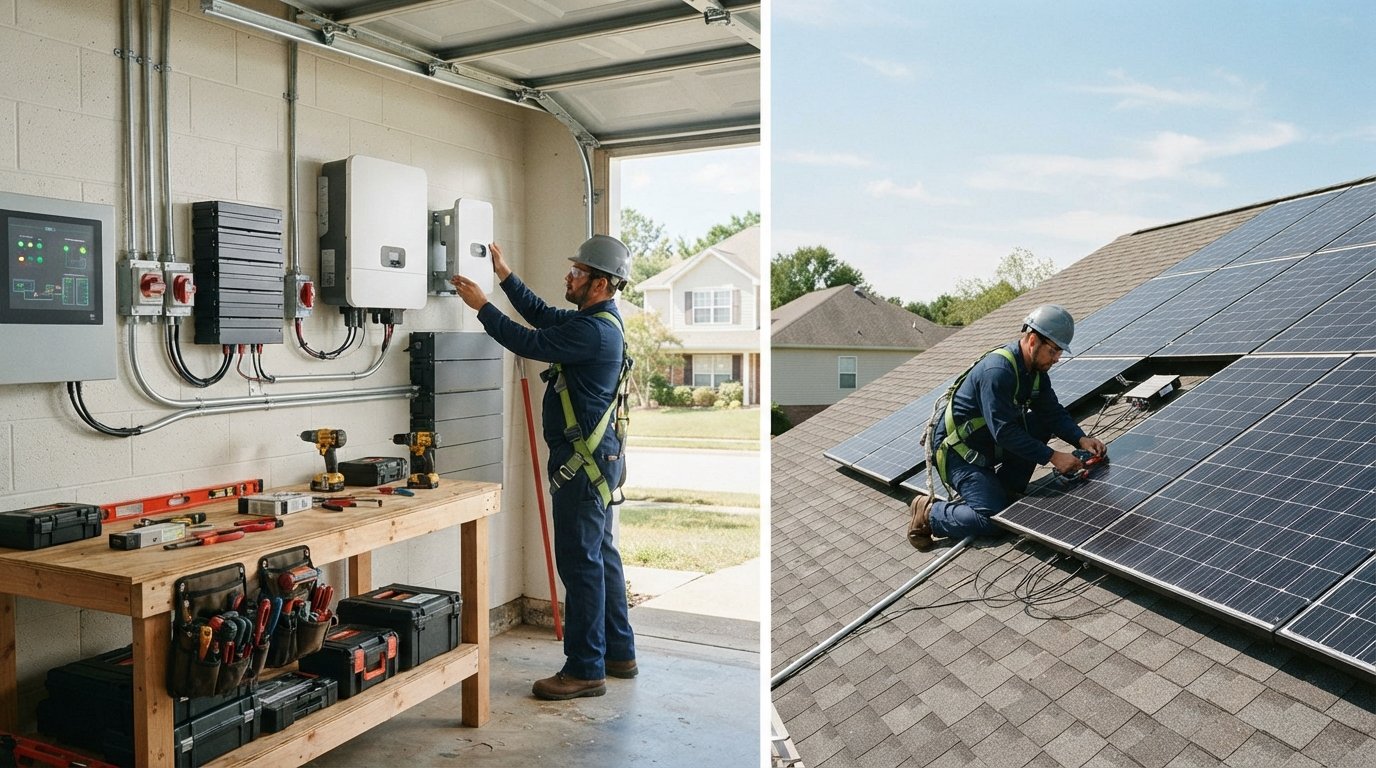
A hybrid solar inverter is a single, centralized unit, usually mounted on a garage or utility wall, that handles DC-to-AC conversion, manages a connected battery bank, and often includes smart monitoring and grid-interactive features. It is called hybrid because it blends solar production with battery storage and grid power in one brain. When the sun is strong, it powers your home and charges the battery. When the grid goes down, many hybrid inverters can island your home and keep critical circuits running. For a deeper look at how these systems perform at scale, see our guide on hybrid solar power plant benefits.
A microinverter, by contrast, is a small device attached to the underside of each individual solar panel. It converts DC to AC right at the panel, then sends household-ready AC power down to your electrical panel. Because every panel has its own inverter, each one operates independently. Shade on one panel does not drag down the rest, and if a single microinverter fails, the remaining panels keep producing. Microinverters do not natively manage batteries, so adding storage usually requires a separate AC-coupled battery system and additional equipment.
The architectural difference creates a cascade of practical trade-offs. Centralized hybrid systems tend to cost less per watt, simplify battery integration, and concentrate maintenance in one accessible location. Distributed microinverter systems tend to perform better on complex roofs, offer panel-level monitoring out of the box, and tolerate shade and soiling more gracefully. Neither is universally superior, which is why the comparison must be tied to your specific site and goals.
Efficiency, Shade Tolerance, and Real-World Performance
Efficiency ratings on spec sheets rarely tell the whole story. Hybrid inverters typically boast peak efficiencies around 97 to 98 percent, and modern microinverters are often in the same range. The meaningful differences emerge in real-world conditions: partial shade, mixed panel orientations, and uneven soiling.
With a hybrid inverter paired with power optimizers, shade on one panel can be mitigated, but the optimizer adds cost and complexity. With microinverters, shade tolerance is built in. If a chimney shadows two panels in the morning, only those two underproduce; the other eighteen panels continue at full output. On a roof with multiple planes facing different directions, microinverters also handle the mismatch more elegantly because each panel finds its own maximum power point.
On a clean, unshaded, south-facing roof, the performance gap narrows to almost nothing. In those ideal conditions, a well-designed hybrid system with optimizers can match or slightly exceed a microinverter system, and it will usually cost less. The decision then shifts toward battery readiness, serviceability, and long-term reliability rather than raw production.
Battery Storage and Backup Power: Where Hybrid Inverters Pull Ahead
If energy independence or backup power is a priority, hybrid inverters have a structural advantage. They are designed from the ground up to manage DC-coupled batteries, which means fewer conversion steps, higher round-trip efficiency, and tighter integration between solar production, storage, and home consumption. A single hybrid inverter can coordinate when to charge, when to discharge, and when to pull from the grid based on time-of-use rates or outage conditions.
Microinverter systems can absolutely support batteries, but they do so through AC coupling. The solar AC power flows to a separate battery inverter, which converts it back to DC for storage, then back to AC when needed. Each conversion introduces small losses, typically a few percentage points, and adds equipment cost. The result is a capable but slightly less efficient storage architecture.
For homeowners who want seamless whole-home backup, hybrid inverters also tend to offer more elegant load management. Many can power critical loads during an outage without the brief interruption that some AC-coupled systems experience. If your goal is to keep the refrigerator, internet, and a few lights running through a multi-hour blackout, both approaches work, but the hybrid path is usually simpler to design and commission.
Cost, Installation, and Long-Term Serviceability
Upfront cost is where the two technologies diverge most visibly. A hybrid inverter is a single high-capacity unit, and its cost is spread across the entire array. Microinverters multiply that cost by the number of panels, so a 25-panel system requires 25 microinverters plus associated cabling and monitoring hardware. On a dollars-per-watt basis, hybrid systems are typically less expensive for the same array size.
Installation labor also differs. Hybrid inverters require one mounting location, one set of DC runs from the roof, and one AC connection. Microinverters require mounting hardware under every panel and often additional trunk cable and junction components. On a simple roof, the labor difference is modest. On a complex roof with multiple arrays, microinverters can actually simplify wiring because the AC output can be daisy-chained.
Serviceability cuts both ways. If a hybrid inverter fails, the entire system stops producing until it is repaired or replaced, though most manufacturers offer rapid replacement programs. If a microinverter fails, only one panel goes offline, but diagnosing and replacing it means getting on the roof, which can be costly and inconvenient. Extended warranties matter here: many microinverters carry 25-year warranties, while hybrid inverters often carry 10 to 12 years, with extensions available.
Here is a quick decision framework to weigh the trade-offs:
- Choose a hybrid inverter if you want battery storage now or soon, your roof is simple and mostly unshaded, and you prefer lower upfront cost and centralized maintenance.
- Choose microinverters if your roof has complex angles, shade, or multiple orientations, and you value panel-level monitoring and per-panel reliability.
- Consider a hybrid plus optimizers if you have moderate shade but still want native battery integration and a single point of management.
- Consider AC-coupled batteries with microinverters if you already have microinverters or want maximum flexibility in battery brand and sizing.
After the list, one more consideration matters: future expansion. Hybrid inverters often have limited battery input capacity, so adding a second battery years later may require a larger inverter or a separate unit. Microinverter systems with AC-coupled storage can scale battery capacity more modularly, though at the cost of additional inverters. Map your five-year plan before committing.
Monitoring, Smart Features, and Grid Interaction
Both systems offer monitoring, but the granularity differs. Microinverters provide panel-level data by default, which makes it easy to spot a dirty panel, a failed unit, or a wiring issue. Hybrid inverters typically monitor at the system level or at the string level, and panel-level visibility requires optimizers or additional monitoring hardware.
Smart features are converging. Many hybrid inverters now include built-in energy management, time-of-use scheduling, generator input, and demand response capabilities. Some microinverter ecosystems offer similar features through companion apps and gateways. If you plan to participate in utility demand response programs or optimize around time-of-use rates, check whether the inverter supports the protocols your utility uses.
Grid interaction is another differentiator. Hybrid inverters are often designed with backup and off-grid modes, making them a natural fit for homes that experience frequent outages or want resilience. Microinverter systems are typically grid-tied unless paired with a separate backup solution. For homeowners in storm-prone regions, this distinction can be decisive.
Which One Should You Choose?
There is no single winner in the hybrid solar inverter vs microinverter comparison. The right choice is a function of your roof, your resilience goals, your budget, and your timeline for storage. A homeowner with a simple, unshaded roof who wants battery backup and the lowest upfront cost will usually be better served by a hybrid inverter. A homeowner with a complex, shaded roof who wants maximum production per panel and panel-level insight will usually prefer microinverters.
Before you decide, gather three data points: a shade analysis of your roof, a clear picture of your backup priorities, and a five-year energy plan. Then compare quotes from vetted installers who can model both options for your specific site. An independent educational resource like NewSolarQuotes can help you understand pricing benchmarks and financing options before you talk to contractors, so you can evaluate proposals with confidence.
Whichever path you choose, the inverter decision will shape your system for decades. Take the time to match the technology to your home rather than chasing a spec sheet. When you are ready, request quotes from qualified solar professionals who can translate these trade-offs into a concrete design for your roof, your budget, and your energy goals.