How to Size a Solar Inverter: Use a Calculator Guide
Discover how a solar panel inverter sizing calculator helps you choose the right inverter, avoid clipping, and maximize energy savings.

By Dylan Harris
Learn more about Solar Panel Installation and Repair for guides, costs, and what to expect.
Compare Solar Panel Installation and Repair Pros Near You

Enter your ZIP code to compare top-rated local professionals and request free quotes.
Choosing the right inverter is one of the most critical decisions you will make when designing a solar panel system. An inverter converts the direct current (DC) electricity generated by your panels into the alternating current (AC) electricity that powers your home. If you select an inverter that is too small, it will limit your system's output and potentially shut down on hot days. If you select one that is too large, you will waste money and reduce efficiency. This is where a solar panel inverter sizing calculator becomes an indispensable tool. It takes the guesswork out of the process, helping you match your panels and inverter for optimal performance, longevity, and return on investment.
In this guide, we will walk you through the fundamentals of inverter sizing, explain why the 1.25 rule matters, and show you how to use a calculator to avoid costly mistakes. Whether you are a homeowner planning a DIY installation or a professional fine-tuning a design, understanding this relationship is essential. We will also cover the differences between string inverters, microinverters, and power optimizers, and how each affects the sizing calculation. By the end, you will be equipped to make an informed decision that maximizes your solar savings and ensures your system runs smoothly for decades.
Why Inverter Sizing Matters More Than You Think
Your solar panels are rated for a specific DC output under standard test conditions (STC), but they rarely produce that exact amount in real-world conditions. Factors like temperature, shading, and orientation cause fluctuations. The inverter's job is to handle these variations and convert as much DC power as possible into usable AC power. If your inverter is undersized, it will "clip" the excess power on sunny days, meaning you lose the energy that your panels could have produced. If it is oversized, the inverter operates at a lower efficiency point more often, and you pay extra for capacity you do not use.
The industry standard is to size the inverter to about 80% to 100% of the panel's DC rating, known as the DC-to-AC ratio. This ratio accounts for real-world losses and ensures the inverter operates near its optimal efficiency. A common rule of thumb is the 1.25 rule: the total wattage of your solar panels should not exceed 1.25 times the inverter's continuous output. For example, a 5,000-watt inverter can safely handle up to 6,250 watts of solar panel capacity. This margin prevents damage to the inverter during peak production and allows for slight panel degradation over time.
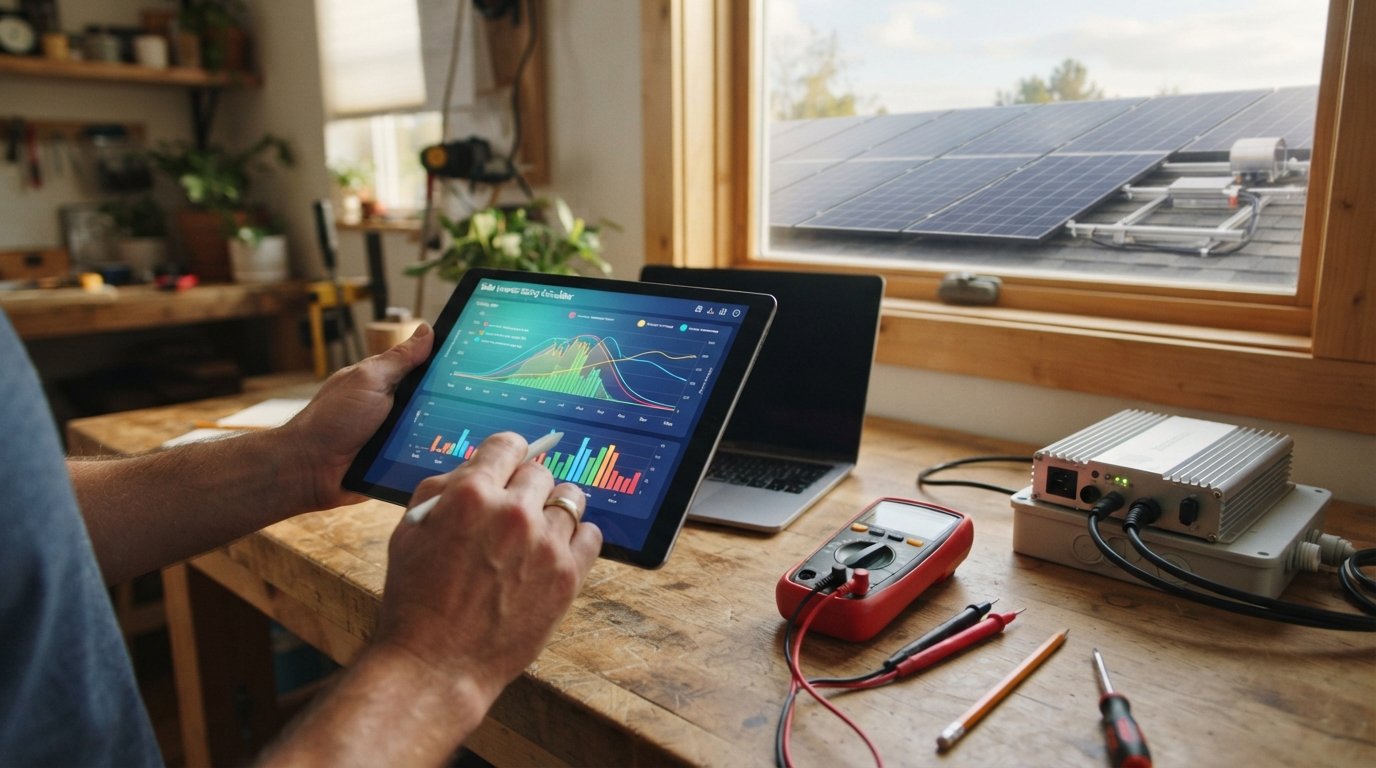
Using a solar panel inverter sizing calculator automates this process. You input your panel wattage, number of panels, and your inverter's specifications, and the calculator tells you if the combination is within safe limits. It also helps you compare different inverter brands and models to find the best fit for your budget and energy goals. Many calculators also account for your local climate, as extreme heat can reduce both panel and inverter efficiency.
Key Inputs for an Accurate Sizing Calculation
To get the most accurate result from a sizing calculator, you need to gather specific information about your solar array and your energy needs. Most calculators ask for the following:
- Panel wattage: The rated DC power output of each solar panel (e.g., 400 watts).
- Number of panels: The total count of panels you plan to install.
- Inverter continuous output: The maximum AC power the inverter can deliver continuously (e.g., 5,000 watts).
- Temperature coefficient: How much the panel's output changes with temperature (usually provided by the manufacturer).
- Local weather data: Annual sunlight hours and average high temperatures in your region.
Once you enter these values, the calculator computes the DC-to-AC ratio and flags any potential issues. For instance, if your ratio is above 1.25, the calculator will warn you that clipping may occur. If it is below 0.8, it will suggest a smaller inverter to save money. Some advanced calculators also estimate annual energy production and payback period, giving you a complete financial picture.
It is important to note that the calculator is a starting point, not a substitute for professional engineering. Your local electrical codes and utility interconnection requirements may impose additional constraints. For example, some utilities limit the inverter size to a certain percentage of your service panel capacity. Always verify your design with a licensed electrician or solar installer before purchasing equipment.
String Inverters vs. Microinverters: How It Affects Sizing
The type of inverter you choose changes how you approach sizing. String inverters are the traditional choice: they connect multiple panels in series, and the combined DC power flows to a single inverter. Sizing a string inverter requires careful matching to the total string voltage and current. If one panel is shaded, it affects the entire string, so you may need to oversize the inverter slightly to compensate for partial shading losses.
Microinverters, on the other hand, are mounted on each individual panel. Each microinverter is sized to the specific panel it serves, typically with a 1:1 ratio or slightly higher. This eliminates the need for a single large inverter and reduces the impact of shading. With microinverters, the sizing calculation is simpler: you just match each panel's wattage to the microinverter's rated output. Many manufacturers offer pairing tools that tell you exactly which microinverter works with which panel.
Power optimizers are a hybrid solution. They are attached to each panel but still feed into a central string inverter. The optimizers condition the DC power to maximize output, allowing for longer strings and more flexible layout. Sizing for power optimizers involves calculating the total optimized DC output and matching it to the string inverter's capacity. A solar panel inverter sizing calculator that supports multiple inverter types will handle these nuances automatically.
Step-by-Step: Using a Solar Panel Inverter Sizing Calculator
Let's walk through a practical example to illustrate how simple this process is. Suppose you have ten 400-watt panels, giving you a total DC capacity of 4,000 watts. You are considering a 3,800-watt string inverter. Input these numbers into a reliable calculator, along with your zip code and roof tilt. The calculator will likely show a DC-to-AC ratio of around 1.05, which is well within the safe range. It will also estimate your annual energy production, perhaps 6,200 kWh, and your potential savings over 25 years.
Now, what if you live in a hot climate like Phoenix, where summer temperatures exceed 110 degrees? The calculator will factor in the temperature coefficient and show a higher clipping loss. It might recommend a slightly larger inverter, say 4,200 watts, to reduce clipping and increase total yield. Alternatively, it might suggest microinverters, which handle heat better and maintain efficiency. This is where the calculator's value shines: it helps you compare scenarios side by side.
Once you have your ideal inverter size, you can use the calculator to test different brands. For instance, if you are choosing between two inverters with the same wattage but different efficiency ratings, the calculator will show the difference in annual output. Over 25 years, a 1% efficiency difference can translate to hundreds of dollars in savings. This level of insight turns a simple sizing tool into a powerful financial planning resource.
Common Mistakes to Avoid When Sizing
Even with a calculator, homeowners often make avoidable errors. One of the most common is ignoring the temperature derating. Inverter and panel ratings are based on 77 degrees Fahrenheit (25 degrees Celsius). On a hot day, panels produce less voltage, and inverters may reduce their output to protect themselves. If you size your inverter based only on the nameplate ratings, you might end up with a system that underperforms in summer. Always input your local high-temperature data into the calculator.
Another mistake is overlooking future expansion. Many homeowners plan to add more panels later, perhaps to charge an electric vehicle or heat a pool. If you size your inverter for your current system only, you will need to replace it sooner than expected. A good calculator will allow you to simulate a future expansion by increasing the number of panels and showing the impact on inverter sizing. This forward-thinking approach saves you money in the long run.
Finally, do not forget about the inverter's maximum input voltage. Even if the wattage matches, exceeding the voltage limit can destroy the inverter. The calculator should include a voltage check, but it is wise to double-check the specifications from the manufacturer. If you are unsure, consult a professional. Many solar companies offer free design reviews, and using one can prevent costly mistakes.
Financial and Performance Benefits of Proper Sizing
Right-sizing your inverter improves your system's performance and your wallet. When the inverter operates at 80-100% of its capacity, it runs at peak efficiency, typically 96-98%. Oversized inverters run at lower loads, which reduces efficiency and increases wear. Undersized inverters clip power on sunny days, losing up to 5% of annual energy production. Both scenarios cost you money over time.
Proper sizing also extends the inverter's lifespan. Inverters have a typical warranty of 10-12 years, but they can last 20 years if operated within their limits. Running an inverter at over 100% capacity for extended periods generates heat, which degrades internal components. A calculator helps you avoid this by keeping the DC-to-AC ratio within the manufacturer's recommended range.
From a financial perspective, the inverter is one of the most expensive components, costing between $1,000 and $3,000 for a residential system. Oversizing by 20% could add $300 to $600 to your upfront cost without any performance benefit. Undersizing might save money initially, but the lost energy production could outweigh those savings in just a few years. A solar panel inverter sizing calculator helps you find the sweet spot that minimizes your net cost over the system's lifetime.
For those looking to maximize savings, consider pairing your inverter sizing with a comprehensive energy assessment. You can also explore how AI in solar panel efficiency can further optimize your system's output. These advanced tools can analyze your consumption patterns and suggest the ideal inverter size for your specific needs.
Tools and Resources for Accurate Sizing
Several free online calculators are available, but not all are created equal. Look for one that allows you to input your specific panel and inverter models, as well as your location. The best calculators use historical weather data and account for local solar irradiance. Some also provide a map of solar potential, so you can see how many peak sun hours your area receives. These details make a significant difference in the accuracy of the results.
Many solar equipment manufacturers offer their own sizing tools on their websites. These are often the most reliable because they use proprietary data about their products. For example, if you are considering a specific microinverter brand, their sizing tool will tell you exactly which panels are compatible and what the expected output will be. However, these tools are limited to their own product lines, so you may need to use multiple tools to compare different brands.
For a more comprehensive analysis, consider using a professional solar design service. Companies like NewSolarQuotes provide free quotes and can help you size your inverter correctly as part of a full system design. They have access to advanced modeling software and local installers who can ensure your system meets all codes and requirements. This is especially valuable if you are considering a complex installation with multiple roof planes or partial shading.
In addition to online calculators, you can use the Solar Savings Calculator on SolarEnergy.ai to estimate your potential savings and system size. This tool gives you a high-level view of your energy needs and helps you understand the financial benefits of going solar. While it does not replace a detailed inverter sizing calculation, it is an excellent starting point.
Final Thoughts on Inverter Sizing
Inverter sizing is not a one-size-fits-all process. It requires careful consideration of your panels, your climate, your energy goals, and your budget. A solar panel inverter sizing calculator simplifies this complexity, providing you with data-driven recommendations in minutes. By taking the time to input accurate information and understanding the results, you can avoid common pitfalls and build a system that delivers reliable, efficient power for decades.
Remember that the calculator is a tool, not a final authority. Always cross-check its recommendations with professional advice, especially if your installation is complex or your local codes have specific requirements. The upfront effort is worth it: a properly sized inverter ensures you get the most from your solar investment, maximizing your savings and minimizing your environmental impact.
Whether you are a seasoned solar enthusiast or a first-time buyer, mastering inverter sizing gives you confidence and control. Use the calculators available, consult with experts, and make an informed choice. Your future self (and your wallet) will thank you.
Learn more about Solar Panel Installation and Repair for guides, costs, and what to expect.
Compare Solar Panel Installation and Repair Pros Near You
Enter your ZIP code to compare top-rated local professionals and request free quotes.