How to Choose the Best Solar Panels for Home in 2026
A practical guide to choosing the best solar panels for home based on efficiency, cost, warranty, and your roof's unique needs.

By Owen Phillips
Learn more about Solar Panel Installation and Repair for guides, costs, and what to expect.
Compare Solar Panel Installation and Repair Pros Near You

Enter your ZIP code to compare top-rated local professionals and request free quotes.
Your electricity bill arrives each month with a little more sting than the last. You have heard that solar panels can slash those costs, but the market is flooded with options. Monocrystalline, polycrystalline, thin-film, high-efficiency, budget-friendly, the choices can feel overwhelming. The truth is, the best solar panels for home use are not a one-size-fits-all product. They depend on your roof, your budget, your local climate, and your long-term energy goals.
This guide cuts through the marketing noise. We will walk through the key performance metrics, compare the top panel types and brands, and give you a clear framework for making a confident decision. By the end, you will know exactly what to look for and how to match a panel to your home's unique needs.
Understanding Solar Panel Efficiency and What It Means for Your Home
Efficiency is the most talked-about spec, but it is often misunderstood. A solar panel's efficiency rating tells you what percentage of sunlight hitting the panel gets converted into usable electricity. Most residential panels range from 15% to 22% efficiency. Higher efficiency means you generate more power per square foot of roof space.
For homeowners with limited roof area, high-efficiency panels (20% or above) are often the best solar panels for home use because they maximize energy production in a small footprint. If you have ample roof space, standard-efficiency panels (15% to 18%) may be a more cost-effective choice, giving you similar total output with a larger array.
Efficiency is not the only factor. Temperature coefficient matters too. Panels lose efficiency as they heat up, and a lower temperature coefficient (closer to -0.25% per degree Celsius) means better performance on hot summer days. In our guide on AI in Solar Panel Efficiency, we explain how smart technology can further optimize panel output by adjusting angles and tracking real-time weather data.
Key Factors That Define the Best Solar Panels for Home
Before comparing specific brands, you need to understand the criteria that separate a good panel from a great one. Here are the most important factors to evaluate:
- Power Rating (Wattage): Measured in watts (W), this indicates the panel's maximum output under standard test conditions. Residential panels typically range from 250W to 400W. Higher wattage panels produce more electricity but may also be physically larger.
- Durability and Degradation Rate: Panels naturally degrade over time. Top-tier panels lose about 0.3% to 0.5% of their output each year. A lower degradation rate means your system stays productive for decades. Look for panels with a power output warranty of 25 years or more.
- Temperature Coefficient: As mentioned, this measures performance in heat. Panels with a coefficient of -0.35% or better are good choices for hot climates like Arizona or Texas.
- Warranty Coverage: The best panels come with a 25-year product warranty (covering defects and workmanship) and a 25-year linear power warranty (guaranteeing a minimum output over time).
- Brand Reputation and Manufacturing Quality: Established manufacturers with strong quality control and financial stability are more likely to honor warranties and support replacement parts down the road.
Balancing these factors against your budget is the real challenge. A premium panel with a 0.3% degradation rate and 22% efficiency may cost 30% more than a solid mid-range panel. For many homeowners, the mid-range option provides the best value over the system's lifetime.
Monocrystalline vs. Polycrystalline vs. Thin-Film: Which Type Wins?
The three main solar panel technologies each have distinct advantages. Here is how they compare for residential use.
Monocrystalline Panels
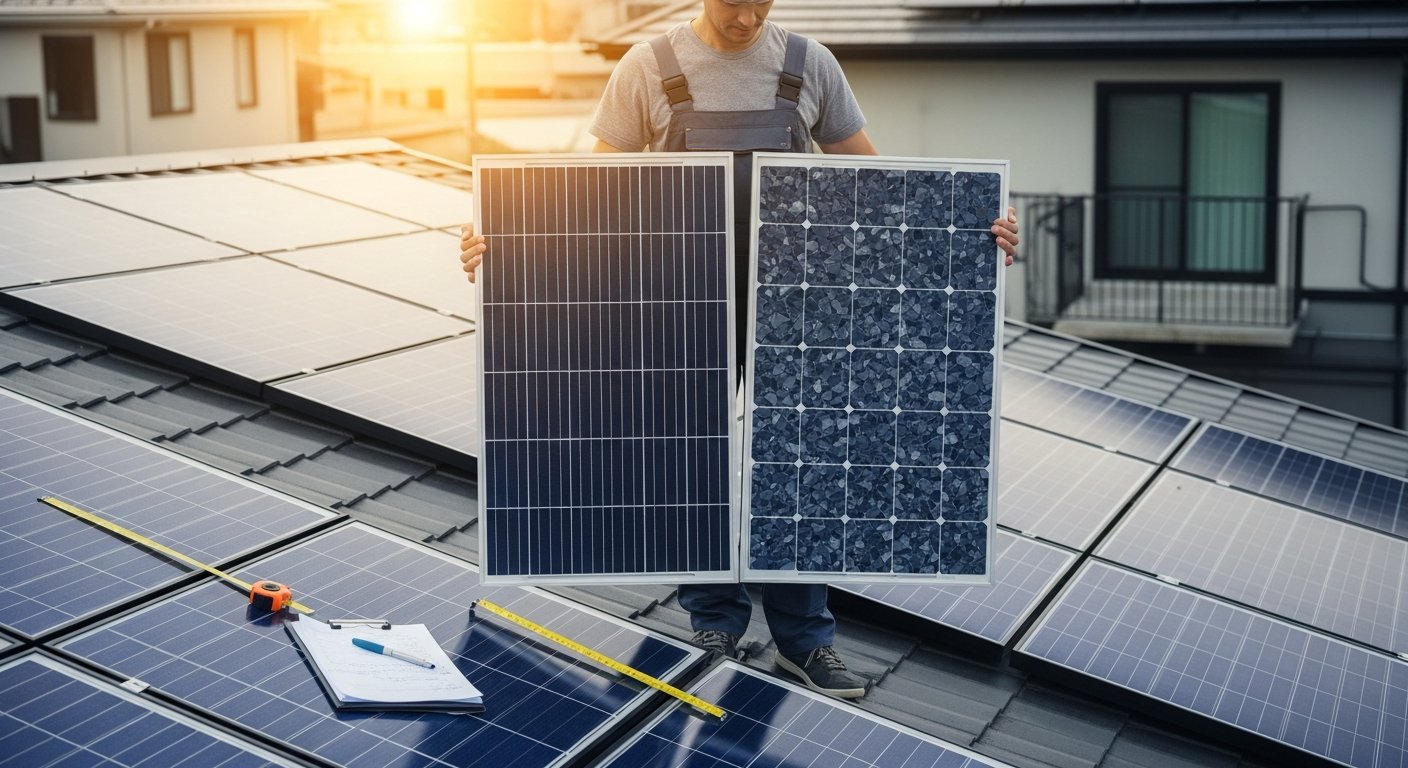
These are the most efficient and popular choice for homes. Made from a single silicon crystal, they have a uniform black or dark blue appearance. Their efficiency ranges from 18% to 22%, and they perform better in low-light conditions than other types. They also have a lower temperature coefficient, making them ideal for warm climates. The trade-off is cost: monocrystalline panels are the most expensive per watt. However, their longevity and performance often justify the investment. For most homeowners, monocrystalline panels represent the best solar panels for home use when roof space is limited.
Polycrystalline Panels
These panels are made from multiple silicon fragments melted together, giving them a speckled blue appearance. Their efficiency is lower (15% to 18%) and they degrade slightly faster than monocrystalline panels. However, they are significantly cheaper, making them a strong option for homeowners with large roofs and a tight budget. If you have plenty of space and want to maximize upfront savings, polycrystalline panels can deliver a solid return on investment.
Thin-Film Panels
Thin-film panels are lightweight and flexible, but they have the lowest efficiency (10% to 13%). They require much more roof area to produce the same power as crystalline panels. They also degrade faster. For these reasons, thin-film panels are rarely the best choice for residential rooftops. They are more commonly used in large commercial installations or on curved surfaces. Unless you have a very specific application (like an RV or a shed), stick with crystalline panels.
Top Solar Panel Brands for Homeowners in 2026
While dozens of manufacturers exist, a handful consistently earn top marks for performance, reliability, and customer satisfaction. Here are the leading brands to consider when shopping for the best solar panels for home installation.
LG Solar (now LG Energy Solution): LG has long been a premium brand known for high efficiency and excellent warranties. Their panels often feature a 25-year product and performance warranty, and they are manufactured with high-quality materials. LG's NeON series is particularly popular for its sleek black design and strong performance in partial shade.
Panasonic Solar: Panasonic's EverVolt series is another top-tier option. These panels combine high efficiency (up to 22.2%) with a low degradation rate (0.25% per year). They also have a robust temperature coefficient, making them a strong choice for hot climates. Panasonic backs its panels with a 25-year warranty that covers both product and performance.
REC Solar: REC is a Norwegian brand that manufactures high-performance panels with a strong focus on sustainability. Their Alpha Pure series uses heterojunction technology for high efficiency and excellent low-light performance. REC offers a 25-year product warranty and a 25-year linear power warranty, and their panels are built to withstand heavy snow and wind loads.
SunPower: SunPower has a reputation for producing the most efficient residential panels on the market, with some models exceeding 22.8% efficiency. Their Maxeon technology uses a unique back-contact cell design that increases durability and reduces hot spots. SunPower panels come with a 25-year combined product and power warranty, and they are known for their long lifespan.
Canadian Solar: For homeowners seeking a balance of cost and quality, Canadian Solar offers reliable panels at a competitive price. Their HiKu series provides solid efficiency (around 20%) and a 25-year power warranty. They are a popular choice for large-scale installations where budget is a primary concern.
Each of these brands has a strong track record. The right choice depends on your specific priorities: maximum efficiency (SunPower, LG, Panasonic), durability and warranty (REC, LG), or value (Canadian Solar). To get an accurate idea of how these panels will perform on your roof and what they will cost, check out Solar Panel Cost Estimates for Homeowners for a detailed breakdown of pricing and payback periods.
How to Match Panels to Your Home's Specific Needs
General brand recommendations are helpful, but your home's unique characteristics will ultimately determine the best choice. Here is a step-by-step framework to narrow down your options.
Step 1: Measure Your Available Roof Space. Walk around your house and note the dimensions of your south-facing roof sections (in the northern hemisphere). Subtract areas occupied by chimneys, vents, skylights, or shaded zones. This gives you your usable roof area. If you have less than 500 square feet, high-efficiency panels (like SunPower or Panasonic) are likely your best bet. If you have more than 800 square feet, you can comfortably use mid-efficiency panels and still meet your energy needs.
Step 2: Calculate Your Annual Energy Consumption. Look at your past 12 months of electricity bills to find your total kilowatt-hour (kWh) usage. Divide that number by 365 to get your daily average. A typical U.S. home uses about 900 kWh per month (30 kWh per day). Your goal is to install a system that covers 80% to 100% of that usage, depending on your budget and net metering policies in your state.
Step 3: Consider Your Local Climate. If you live in a hot, sunny region (like the Southwest), prioritize panels with a low temperature coefficient. If you live in a cloudy area (like the Pacific Northwest), look for panels with strong low-light performance (monocrystalline panels generally excel here). If you face heavy snow, choose panels with high snow load ratings and a sturdy frame.
Step 4: Evaluate Your Budget and Payback Timeline. Premium panels cost more upfront but may offer a slightly faster payback period due to higher efficiency and lower degradation. Budget panels have a lower initial cost but may produce less energy over time and require replacement sooner. Use a solar ROI calculator to compare total lifetime savings for different panel options.
Step 5: Check Warranty and Installer Reputation. Even the best solar panels for home use are only as good as their installation. Work with a certified, experienced installer who offers a workmanship warranty (typically 10 to 25 years). The installer should be able to provide references and explain how they handle warranty claims for panels and inverters.
Inverters: The Unsung Heroes of Your Solar System
Too many homeowners focus exclusively on panels and overlook the inverter. The inverter converts the direct current (DC) electricity generated by your panels into alternating current (AC) electricity that your home can use. There are three main types:
- String Inverters: These are the most common and affordable option. All panels are connected in a series (a string), and the inverter converts the combined power. The downside is that if one panel is shaded or underperforming, it drags down the output of the entire string. String inverters work well for roofs with uniform sunlight and no shading.
- Microinverters: These are small inverters attached to each individual panel. Each panel operates independently, so shading on one panel does not affect the others. Microinverters also allow for panel-level monitoring, making it easy to spot performance issues. They are more expensive but often worth the investment for roofs with partial shading or complex angles.
- Power Optimizers: These are a hybrid solution. They are attached to each panel to condition the DC power before sending it to a central string inverter. Power optimizers offer many of the benefits of microinverters (panel-level optimization and monitoring) at a slightly lower cost.
When selecting your inverter, consider your roof's shading profile and your desire for monitoring. For most homes with minimal shading, a quality string inverter paired with power optimizers is an excellent balance of cost and performance. For roofs with significant shading or multiple orientations, microinverters are often the better choice.
Battery Storage: Should You Add It Now or Later?
Solar batteries allow you to store excess energy generated during the day for use at night or during a power outage. They are not essential for every home, but they add energy independence and can increase your savings if your utility has time-of-use rates or limited net metering.
If you live in an area with frequent power outages or a utility that does not offer full retail net metering, a battery can be a smart addition. Popular home battery options include the Tesla Powerwall, LG Chem RESU, and Enphase Encharge. The cost of batteries has been dropping, but they still represent a significant investment (typically $7,000 to $15,000 installed).
Many homeowners choose to install a solar-only system first and add batteries later. Most modern inverters are battery-ready, meaning you can connect a battery without replacing your inverter. If you decide to go this route, make sure your installer uses equipment that supports future battery integration.
Government Incentives and Tax Credits
The federal solar investment tax credit (ITC) currently allows you to deduct 30% of your total solar installation cost from your federal taxes. This credit applies to both panels and batteries (if they are charged primarily by solar). Many states and local utilities offer additional rebates, performance-based incentives, or property tax exemptions.
To maximize your savings, research the incentives available in your state before signing a contract. The Database of State Incentives for Renewables and Efficiency (DSIRE) is a reliable resource for this information. Your installer should also be able to help you navigate the paperwork. Remember that tax credits reduce your tax liability, not your taxable income, so consult a tax professional to understand how the credit applies to your specific situation.
Making Your Final Decision
Choosing the best solar panels for home use is a personal decision that balances efficiency, cost, warranty, and aesthetics. Start by getting at least three quotes from reputable installers. Compare the panel brands they offer, the inverter type, the warranty terms, and the total installed price per watt. Do not automatically choose the cheapest quote. A slightly higher upfront cost for a premium panel and a strong installer warranty can save you money and headaches over the 25-year lifespan of your system.
Ask each installer for a detailed energy production estimate based on your specific roof and location. This estimate should account for shading, roof angle, and local weather patterns. Use these estimates to calculate your payback period and total 25-year savings. With a clear understanding of your needs and the options available, you can confidently invest in a solar system that will lower your electricity bills, increase your home's value, and reduce your carbon footprint. For a deeper look at how technology is reshaping solar output, read our article on AI in Solar Panel Efficiency: Boost Your Home Savings.
The shift to solar is one of the most impactful home improvements you can make. By focusing on the factors that matter most for your specific situation, you can find the perfect panels and start generating clean, affordable energy for decades to come.
Learn more about Solar Panel Installation and Repair for guides, costs, and what to expect.
Compare Solar Panel Installation and Repair Pros Near You
Enter your ZIP code to compare top-rated local professionals and request free quotes.