Home Energy Audit: What to Expect and How to Prepare
A home energy audit reveals hidden inefficiencies that inflate your bills. Learn what the process involves and how the findings can cut costs and boost comfort.

By Owen Phillips
Learn more about Weatherization for guides, costs, and what to expect.
Compare Weatherization Pros Near You

Enter your ZIP code to compare top-rated local professionals and request free quotes.
Imagine opening your utility bill and seeing a number that makes you wince. You have already swapped out light bulbs, unplugged devices, and adjusted the thermostat, yet your energy costs remain stubbornly high. You have heard that an energy audit can help, but you are not sure what the process involves or whether it is worth the time and money. Understanding what a home energy audit entails can be the difference between throwing money at symptom fixes and making targeted upgrades that actually lower your bills and improve comfort.
The Purpose of a Professional Home Energy Audit
A home energy audit, sometimes called an energy assessment, is a detailed evaluation of how your home uses energy and where it loses it. The auditor’s goal is to identify inefficiencies in the building envelope, heating and cooling systems, water heating, and major appliances. The result is a prioritized list of recommendations that can range from simple weatherstripping to major insulation upgrades or even solar panel installation.
Most homeowners schedule an audit because they notice high utility bills, uneven room temperatures, drafts, or condensation on windows. Others do it before making a large purchase like a new HVAC system or a solar array. The audit provides a data-driven baseline so you do not oversize or undersize equipment and so you can see which upgrades will deliver the fastest payback.
During the audit, the professional will review your energy consumption history, inspect the home’s exterior and interior, and use specialized equipment to measure air leakage and insulation levels. The process typically takes two to four hours for an average home, and you should plan to be present for at least part of it to answer questions and point out problem areas.
What Happens Before the Auditor Arrives
Preparation starts before the technician knocks on your door. A good auditor will ask you to gather your past 12 months of utility bills, note any rooms that are consistently too hot or too cold, and list any existing moisture or mold issues. If you have had recent renovations, you should share those details because they can affect the building envelope and air sealing.
You should also make sure the auditor has easy access to the attic, crawlspace, basement, and mechanical closets. Move stored items away from the furnace, water heater, and electrical panel so the inspector can examine them thoroughly. Clear any clutter near windows and exterior doors as well.
One of the most useful things you can do is walk through your home a day before the audit and note every draft you feel near windows, doors, outlets, and baseboards. This list will help the auditor focus on the areas that matter most to you, and it gives you a chance to ask specific questions about the causes and solutions.
The Core Components of the Audit
When the auditor arrives, they will typically begin with a visual inspection of the exterior, checking for gaps around windows and doors, signs of water damage, and the condition of the siding and foundation. Then they will move inside to inspect the attic, walls, floors, and the HVAC system. This is not a quick walkthrough; it is a methodical examination that often includes the following steps.
Blower Door Test. The most important diagnostic tool is the blower door, which is a powerful fan mounted in an exterior door frame. It depressurizes the home and measures how much air leaks through cracks and openings. The lower the number, the tighter the home. The test also helps the auditor locate leaks using a smoke pencil or an infrared camera while the house is under negative pressure.
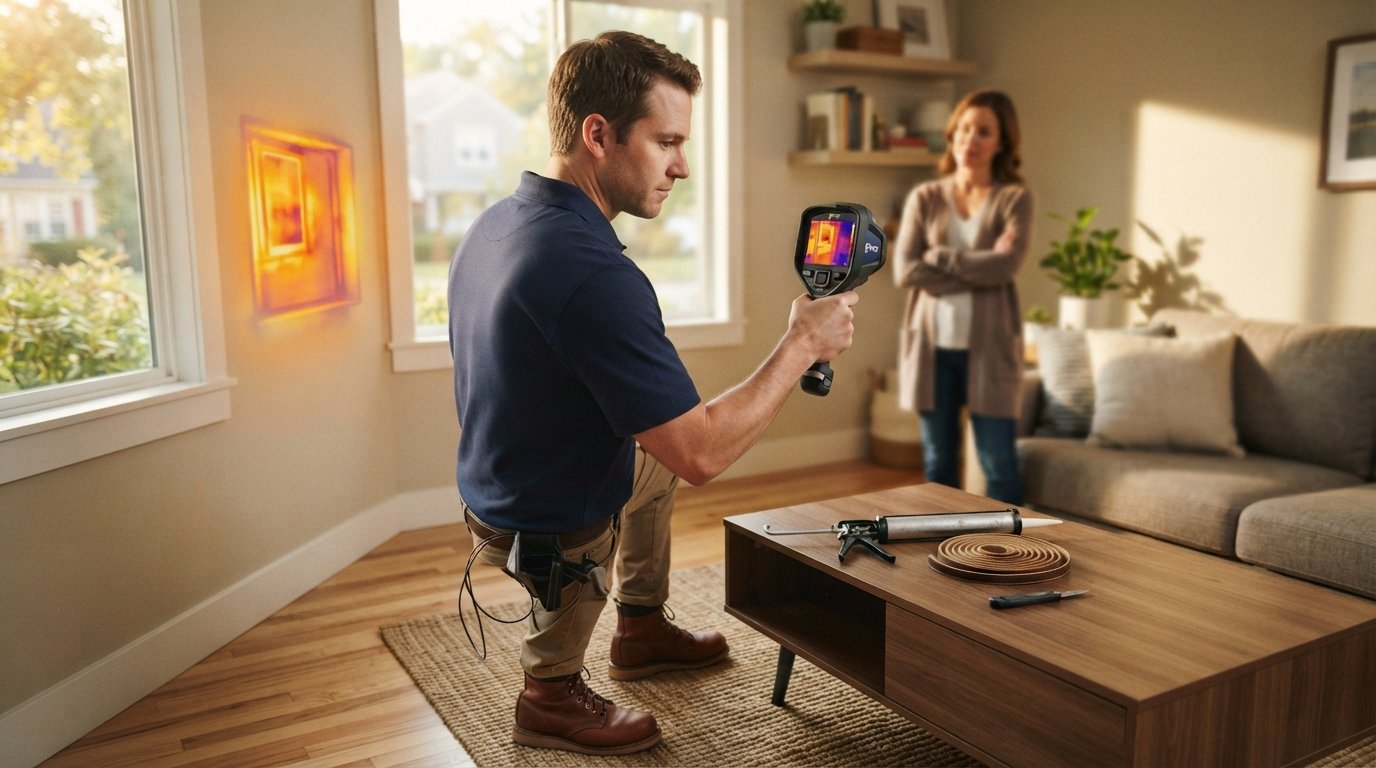
Thermographic Inspection. An infrared camera scans surfaces to show temperature differences that reveal missing insulation, air leaks, and moisture intrusion. This is especially valuable in the attic and around windows, where invisible gaps can cause significant energy loss. The images provide a visual record you can use when hiring contractors for upgrades.
Combustion Safety Testing. If you have gas appliances, the auditor will check for carbon monoxide leaks and ensure that combustion gases are venting properly. This is a critical safety step, because a tightly sealed home can trap dangerous gases if the HVAC system is not operating correctly.
Appliance and Lighting Review. The auditor will inventory your major appliances, lighting types, and water heater settings to estimate their efficiency and identify easy wins like upgrading to LED bulbs or installing a programmable thermostat.
At the end of the assessment, you should receive a detailed report that includes the results of the tests, a list of recommended improvements, and an estimate of the energy savings for each item. The recommendations are usually ranked by cost and return on investment, from low-cost weatherstripping to high-impact insulation and equipment replacement.
What the Report Includes and How to Read It
The audit report is your roadmap to a more efficient home. It will typically include a summary of your home’s current energy performance, the results of the blower door test in air changes per hour (ACH), and the R-values of your insulation. It will also list specific deficiencies, such as unsealed ductwork, gaps around plumbing penetrations, or insufficient attic insulation.
Look for the section that estimates the annual savings for each recommended upgrade. This is where you can compare the upfront cost to the monthly savings to calculate the payback period. For example, if air sealing costs $400 and saves $150 per year, the payback is less than three years. That is a strong investment. On the other hand, replacing a 15-year-old water heater might have a longer payback, but it could still be worthwhile if the unit is nearing the end of its life.
The report should also include any safety issues, such as a cracked heat exchanger or improper ventilation. Address these immediately, even if they are not the biggest energy savers, because they affect your family’s health.
One common misconception is that an audit is only useful for older homes. Newer homes can also benefit because construction defects, poor duct sealing, and improperly installed insulation are not uncommon. An audit gives you peace of mind that your home is performing as designed and that you are not paying to heat or cool the outdoors.
Common Recommendations and Their Impact
After the audit, you will likely receive a list of improvements. While every home is different, most audits produce a similar set of high-priority items. Here are the most common recommendations, along with their typical impact.
- Air sealing: Sealing cracks and gaps in the building envelope can reduce heating and cooling losses by 10 to 20 percent, according to the U.S. Department of Energy.
- Attic insulation: Adding insulation to the attic floor is often the most cost-effective upgrade, especially if you live in a climate with extreme temperatures.
- Duct sealing: Leaky ducts can waste up to 30 percent of conditioned air, so sealing them improves comfort and reduces energy use.
- Window weatherization: Replacing old weatherstripping and adding caulk around window frames can eliminate drafts without the cost of new windows.
- HVAC tune-up: Cleaning and servicing your heating and cooling system ensures it runs efficiently and extends its lifespan.
These improvements do more than lower your utility bills. They also increase comfort by eliminating drafts and cold spots, reduce noise from outside, and improve indoor air quality by preventing moisture and pollutants from entering. Many homeowners are surprised by how much more comfortable their home feels after just a few hours of air sealing and insulation work.
If the audit reveals that your home is already well insulated and sealed, you may want to focus on the efficiency of your equipment and appliances. Upgrading to an ENERGY STAR rated heat pump or water heater can yield significant savings, and pairing those upgrades with a solar panel system can further reduce your reliance on the grid. For a deeper look at how solar fits into the picture, you can explore our analysis of why solar analytics matter for home energy savings.
How to Choose an Energy Auditor
Not all energy audits are created equal. Look for a certified professional, such as one credentialed by the Building Performance Institute (BPI) or the Residential Energy Services Network (RESNET). These certifications ensure the auditor has undergone rigorous training and adheres to industry standards.
Ask about the specific tests they perform. A reputable auditor will use a blower door and an infrared camera, not just a clipboard and a flashlight. They should also be willing to explain their findings in plain language and answer your questions. Be wary of anyone who tries to sell you a specific product during the audit, as this can be a sign of a conflict of interest.
Costs for a professional audit typically range from $200 to $600, depending on the size of your home and the depth of the testing. Many utility companies offer rebates or free audits for their customers, so check with your utility provider before paying out of pocket. Some states also offer incentives for audits and subsequent upgrades through their energy efficiency programs.
If you are handy, you can perform a basic self-audit by inspecting for drafts, checking insulation levels, and reviewing your energy bills. However, a professional audit with diagnostic equipment will uncover issues you cannot see, such as hidden air leaks inside wall cavities or ductwork that is disconnected.
Turning Audit Results into Action
Once you have the report, the next step is prioritization. Start with the items that have the shortest payback and the highest impact. Air sealing and insulation upgrades often pay for themselves within a few years, and they make every other system in your home work more efficiently.
For larger projects, such as HVAC replacement or solar installation, you may need to plan your budget and timeline. The audit report gives you the data to make informed decisions and to get accurate bids from contractors. When you are ready to move forward, a service like NewSolarQuotes can help you compare options for solar panel installation, ensuring you get a system sized correctly for your home’s actual energy use.
It is also wise to schedule a follow-up audit after completing major upgrades. This verifies that the work was done correctly and that the projected savings are being realized. Some auditors offer post-renovation testing at a reduced rate, which is a worthwhile investment for large projects.
Long-Term Benefits Beyond Lower Bills
An energy audit is not a one-time event. It is the foundation of a long-term strategy for managing your home’s energy use. By understanding your home’s baseline, you can track the impact of future changes, whether that is adding smart thermostats, upgrading windows, or installing a solar array. The audit also helps you prioritize improvements so you are not spending money on low-impact measures.
There is also a significant comfort benefit. A well-sealed, well-insulated home maintains a more consistent temperature from room to room, which means fewer hot and cold spots. You will also notice reduced noise from outside and less dust and pollen entering your living space. For families with allergies or asthma, this can be a meaningful improvement in indoor air quality.
Finally, an audit can increase the resale value of your home. Buyers are increasingly looking for energy-efficient features, and a documented audit can be a selling point. It shows that the home has been cared for and that the systems are operating efficiently.
In summary, a home energy audit is a smart investment for any homeowner who wants to reduce utility bills, improve comfort, and make informed decisions about upgrades. The process is thorough, the findings are actionable, and the benefits extend far beyond the initial cost. Whether you are planning a major renovation or just want to stop drafts, the audit gives you the clarity you need to act with confidence.