Home Energy Audit: Find Hidden Waste Before Solar
A home energy audit exposes hidden energy waste before solar, so you buy a smaller system and save more. Call 8334344023 to get started.

By Dylan Harris
Learn more about Weatherization for guides, costs, and what to expect.
Compare Weatherization Pros Near You

Enter your ZIP code to compare top-rated local professionals and request free quotes.
Most homeowners decide to go solar because they want lower electric bills. They call an installer, sign a contract, and wait for the savings to roll in. Then the first post-solar utility statement arrives, and the numbers look surprisingly flat. The system is working. The panels are clean. So what went wrong? In a huge share of cases, the answer is simple: the house was wasting energy long before the panels went up, and solar cannot fix a leak.
Every kilowatt-hour of hidden waste in your home has to be paid for twice. First you pay the utility for power you never really needed. Then you pay the solar company for extra panels to cover that unnecessary load. A home energy audit is the step that exposes those losses, quantifies them, and tells you which fixes deliver the fastest payback. Done before you size a solar array, it can shrink the system you need, cut your upfront cost, and make every panel you do buy work harder.
This guide walks through how a professional audit works, what it typically uncovers, how to translate audit findings into system sizing decisions, and where technology like AI monitoring fits into the picture. If you are serious about maximizing the return on a solar investment, the audit is not an optional extra. It is the foundation.
Why Auditing Before Solar Changes the Math
Solar sizing tools almost always start with historical electricity usage. If your last twelve months of statements show 14,000 kWh, the calculator designs a system to produce roughly 14,000 kWh. That approach assumes your consumption is fixed, but a large portion of it is not. It is behavior, leaky ductwork, an old refrigerator in the garage, or a water heater running at a scalding set point.
When you reduce waste first, the array you need gets smaller. A smaller array costs less, may fit on a better roof plane, and can qualify for a simpler financing structure. The federal residential clean energy credit covers a percentage of your system cost, so trimming the system size does trim the credit itself, but the net out-of-pocket expense still falls because you are buying fewer panels, less racking, and less labor. Meanwhile, your monthly savings as a percentage of the smaller bill often looks better in the eyes of lenders and appraisers.
There is a second, less obvious benefit: efficiency upgrades and solar have different cost curves. A smart thermostat, air sealing, and LED retrofits often pay for themselves in two to four years. Solar typically pays back over a longer horizon. Doing the cheap fixes first means the expensive fix, solar, gets applied to a smaller problem. That sequencing is the entire reason energy auditors exist.
What a Professional Home Energy Audit Actually Includes
A credible audit is more than a walkthrough with a clipboard. It combines visual inspection, diagnostic testing, and data analysis, and it produces a report you can hand to contractors. The scope varies by climate and home type, but most comprehensive audits follow a similar structure.
The auditor begins with a room-by-room survey. They check insulation levels in the attic, walls, and rim joists, look for gaps around penetrations, examine windows and doors, and inspect the mechanical systems: furnace, air conditioner, water heater, ductwork, and ventilation. They note the age and efficiency rating of each major appliance, because a twenty-year-old refrigerator or a failing pool pump can dominate a household load profile.
Then come the diagnostic tests, which are where the real discoveries happen.
- Blower door test: A calibrated fan mounts in an exterior doorway and depressurizes the house. The measured airflow reveals how leaky the building envelope is, and a smoke pencil or thermal camera can pinpoint exactly where air is escaping.
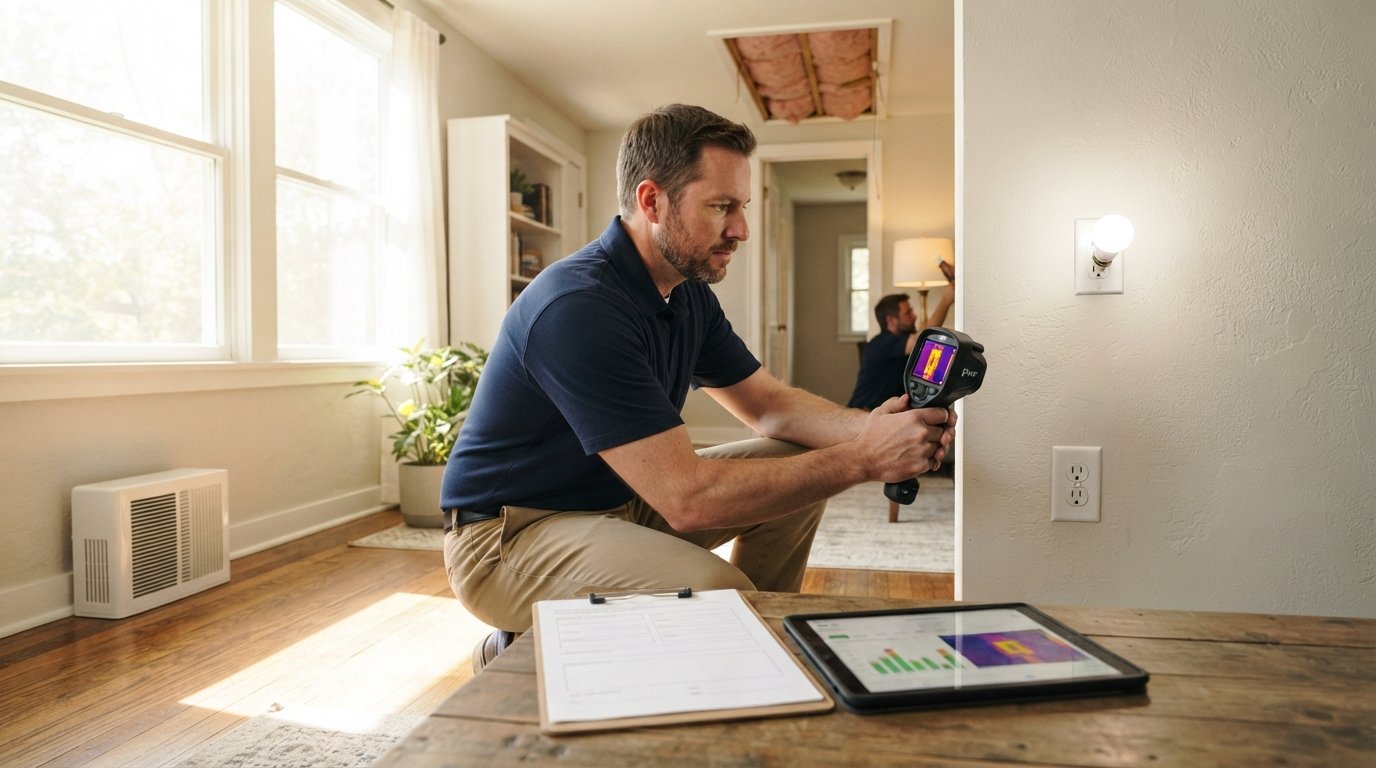
- Thermal imaging: Infrared cameras expose missing insulation, hidden moisture, and overheating electrical components that a visual inspection would miss.
- Duct leakage testing: In homes with forced-air systems, duct losses of 20 to 30 percent are common. The test quantifies how much conditioned air is dumping into the attic or crawlspace instead of your living room.
- Combustion safety and ventilation checks: These confirm that gas appliances are drafting correctly and that the house is not depressurized to the point of backdrafting.
- Appliance and plug-load measurement: Plug-in meters and panel-level monitoring identify phantom loads, failing compressors, and always-on devices that quietly add up.
After the testing, the auditor models the home in energy software and produces a report with prioritized recommendations, estimated costs, and projected savings for each measure. A good report separates quick wins from long-term capital projects and shows the interaction between them, because air sealing and insulation work together, and doing one without the other can undercut the results.
The Hidden Energy Waste an Audit Usually Finds
Every home is different, but certain categories of waste show up again and again. Knowing what to expect helps you evaluate audit findings and push back if a report feels thin.
Air leakage is the most common culprit. A typical older home leaks the equivalent of leaving a window open year-round. Sealing attic hatches, recessed light fixtures, plumbing penetrations, and rim joists is inexpensive and often cuts heating and cooling loads by 10 to 20 percent. Insulation gaps compound the problem, especially in attics where builders sometimes compress batting or skip the corners entirely.
Duct losses come next. If your ducts run through an unconditioned attic, and many do in hot climates, you are paying to cool the attic. Sealing and insulating ducts is one of the highest-return measures an auditor can recommend, and it directly reduces the load your future solar array has to serve.
Then there are the silent electrical loads. Older refrigerators and freezers, cable boxes, game consoles, and always-on chargers can add hundreds of kilowatt-hours a year. A failing well pump or pool pump can add thousands. Water heating is another frequent offender: a tank set to 150 degrees instead of 120 wastes energy every single day, and uninsulated hot water pipes bleed heat into unconditioned spaces.
Finally, there are behavioral and control issues. Thermostats programmed for comfort rather than efficiency, HVAC fans left running continuously, and lighting that has never been converted to LEDs all show up in audit reports. None of these are glamorous, but together they often represent 15 to 30 percent of total household consumption, which is precisely the load that would otherwise drive your solar system size.
From Audit Findings to a Right-Sized Solar System
Once the audit is complete, the next step is translating findings into a solar design. This is where sequencing matters most. You do not want to install panels and then discover that a duct sealing project would have eliminated two kilowatts of array capacity.
A practical sequence looks like this. First, complete the low-cost measures: air sealing, LED conversion, thermostat programming, water heater temperature adjustment, and pipe insulation. Second, complete the mid-cost measures that affect load: duct sealing and insulation, attic insulation upgrades, and replacement of any appliance that the audit flagged as a major consumer. Third, re-measure your usage for a few months if possible, or at minimum recalculate your expected load using the audit model. Fourth, size the solar system against the reduced load, not the historical one.
This sequence has a financial logic. Efficiency measures reduce the load permanently, and their savings accrue whether or not you ever install solar. Solar then covers what remains. If you install solar first, you are financing efficiency problems at solar prices, which is the most expensive way to solve them.
Modern optimization tools make this easier. Platforms that use AI to analyze consumption patterns can identify waste that a one-time audit might miss, such as equipment that only misbehaves in certain seasons or loads that spike at specific times of day. You can read more about that approach in this guide to how AI reduces energy waste and cuts solar costs, which explains how continuous monitoring complements a traditional audit.
Costs, Incentives, and Payback for Audits and Retrofits
Audit pricing varies widely by market and scope. A basic walkthrough assessment might be free or low-cost through a utility program, while a comprehensive audit with blower door and thermal imaging typically runs a few hundred dollars. Many utilities and state programs offer rebates that cover part or all of the cost, and some weatherization programs serve income-qualified households at no charge.
Efficiency retrofits also qualify for incentives. The federal energy efficient home improvement credit covers a percentage of qualifying insulation, air sealing, windows, and heat pump installations, subject to annual caps. State and utility rebates often stack on top. Because these programs change frequently, always verify current amounts with official sources or a qualified contractor before budgeting.
Payback periods for efficiency measures are usually shorter than solar payback. Air sealing and attic insulation often return their cost in two to five years. Duct sealing in a hot climate can be even faster. When you stack those savings with a right-sized solar array, the combined project typically outperforms a larger solar-only installation on both total cost and long-term return.
If you want a rough sense of how efficiency changes the solar equation, run your numbers through a reputable solar savings calculator before and after you adjust your expected usage downward. The difference in recommended system size is often the clearest argument for auditing first.
How to Choose an Auditor and Avoid Common Mistakes
Not every audit is created equal, and not every contractor who offers one is qualified. Look for credentials such as BPI Building Analyst or HERS rater certification, and ask whether the audit includes blower door and thermal imaging or just a visual inspection. Request a sample report so you can see how recommendations are prioritized and whether savings estimates are backed by modeling.
Watch for these common mistakes:
- Auditing after signing a solar contract: By then the system size is locked and the efficiency findings cannot influence the design.
- Accepting a visual-only inspection: Without diagnostic testing, you are guessing at air leakage and duct losses.
- Ignoring the report: An audit that sits in a drawer saves nothing. Budget for the top two or three measures and schedule them.
- Over-upgrading: Not every recommendation has a fast payback. Focus on measures with strong savings-to-cost ratios before tackling cosmetic improvements.
- Forgetting to re-measure: After retrofits, check your usage against the audit model. If savings fall short, investigate before sizing solar.
If you would rather not manage the process alone, a platform that connects homeowners with vetted solar professionals can also coordinate energy surveys and efficiency work. SolarEnergy.ai, for example, offers on-site energy surveys alongside its installer matching service, so the audit and the solar design are handled as one project rather than two disconnected transactions. That integration is exactly what prevents the classic mistake of overbuilding an array to compensate for a leaky house.
The Bottom Line on Auditing Before You Go Solar
Solar is a powerful tool, but it is a supply-side solution. It makes electricity cleaner and often cheaper, yet it does nothing about demand. Every inefficiency in your home raises the amount of solar capacity you must buy, and that raises your cost, your payback period, and your financing burden. A home energy audit flips the order of operations: reduce first, then generate.
The homeowners who get the best results from solar are rarely the ones who buy the biggest system. They are the ones who understand their load, eliminate the waste they can, and size the array to match what is left. That approach consistently produces lower bills, faster payback, and a system that performs exactly as promised. Before you sign a solar contract, schedule the audit. Your future utility statements will show the difference.