Flow Batteries vs Solid State Solar Storage: 2026 Next Gen Guide
Compare flow batteries versus solid state solar storage next generation for your home. Call 8334344023 for expert guidance on the right system.

By Dylan Harris
Learn more about Solar Panel Installation and Repair for guides, costs, and what to expect.
Compare Solar Panel Installation and Repair Pros Near You

Enter your ZIP code to compare top-rated local professionals and request free quotes.
When homeowners ask whether they should wait for solid state batteries or invest in flow batteries for their solar storage, the honest answer is that both technologies are arriving faster than most people expect, and each one solves a different problem. The real question is not which one wins, but which one fits your property, your budget, and your energy goals over the next decade. This guide breaks down the flow battery versus solid state solar storage debate for next generation systems, so you can make a confident decision instead of a speculative one.
Why Next Generation Storage Matters for Solar Owners
Solar panels have become dramatically cheaper and more efficient over the past fifteen years, but storage has lagged behind. Lithium ion batteries dominate today, yet they carry well known limitations: gradual capacity fade, thermal management requirements, and supply chains that remain sensitive to global market swings. As more American households add rooftop solar and face time of use rates, demand charges, and grid reliability concerns, the storage layer has become the bottleneck that determines whether a solar investment truly pays off.
That is why flow batteries and solid state batteries have moved from laboratory curiosity to commercial conversation. Both promise longer life, better safety, and lower lifetime cost per kilowatt hour than conventional lithium ion. But they achieve those goals through completely different physics. Understanding that difference is the key to predicting which technology will serve your home or business best.
Grid operators are also watching closely. As renewable penetration rises, utilities need storage that can shift energy across four to twelve hour windows, not just one or two hours. A homeowner who installs the wrong storage architecture in 2026 could face an expensive replacement before the panels themselves reach mid life.
How Flow Batteries Work and Where They Excel
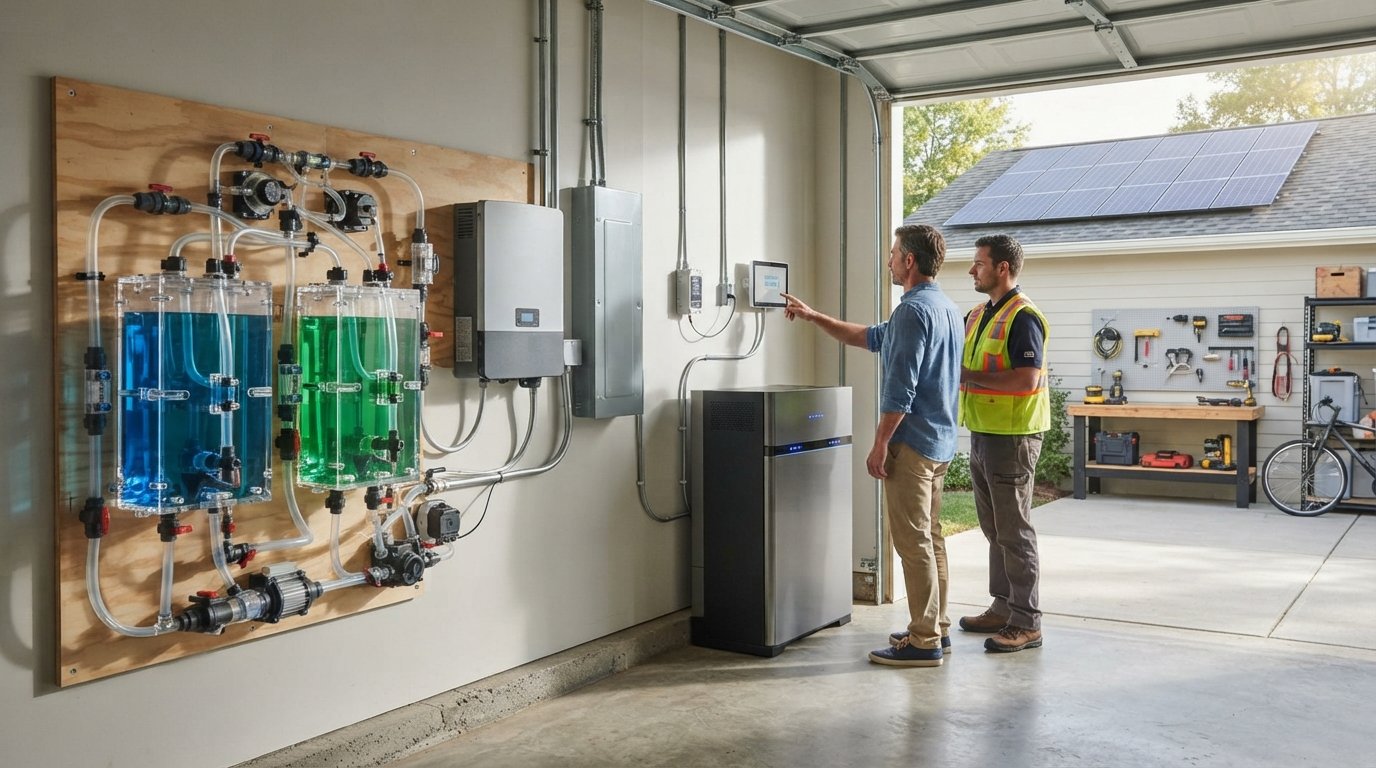
Flow batteries store energy in liquid electrolytes held in external tanks. When the system charges or discharges, those liquids pump through a stack of cells where an electrochemical reaction takes place. Because the energy capacity is determined by tank size and the power rating by stack size, flow batteries decouple power from capacity in a way that lithium ion cannot. Want eight hours of storage instead of four? You simply add more electrolyte, not an entirely new battery module.
This architecture delivers several practical advantages for solar owners. Flow batteries can cycle tens of thousands of times with minimal degradation, often lasting twenty years or more. They do not suffer thermal runaway, which means no fire suppression systems or strict clearance requirements. And their electrolytes can often be refurbished or replaced rather than discarded, which improves long term sustainability.
Consider a small business in Phoenix that runs heavy air conditioning loads from June through September. Its peak demand charges can exceed several hundred dollars per month. A flow battery sized for six hours of discharge can shave that peak every afternoon, and its capacity will still be above ninety percent after a decade of daily cycling. That is a compelling economic story.
Flow batteries do have tradeoffs. They are physically larger, require pumps and plumbing, and have lower round trip efficiency than lithium ion, typically in the sixty five to seventy five percent range. For a homeowner with limited garage or utility room space, that footprint can be a dealbreaker. For rural properties, farms, or commercial sites with available square footage, it is rarely an issue.
How Solid State Batteries Work and Why They Generate Hype
Solid state batteries replace the liquid or gel electrolyte in a conventional lithium ion cell with a solid material, often a ceramic, sulfide, or polymer compound. That single change unlocks a cascade of benefits: higher energy density, faster charging, reduced fire risk, and the potential for lithium metal anodes that store far more energy per kilogram.
For solar storage specifically, solid state batteries promise a compact wall mounted unit that holds more usable energy than today's powerwalls while lasting longer and operating safely at higher temperatures. Automakers have poured billions into the technology because electric vehicles benefit enormously from lighter, denser packs. That investment is now spilling over into stationary storage, where the same cells can be repurposed.
The catch is manufacturing maturity. Solid state cells remain difficult to produce at scale with consistent quality, and costs are still significantly higher than lithium ion on a per kilowatt hour basis. Several manufacturers have announced residential products, but widespread availability and competitive pricing are still emerging. Early adopters in 2026 may pay a premium for a technology that will look far more affordable by 2029 or 2030.
Homeowners who value a small physical footprint, minimal maintenance, and seamless integration with smart home energy management will find solid state appealing. Those who need maximum cycle life, scalable capacity, and inherent safety may prefer flow batteries even after solid state matures.
Flow Batteries Versus Solid State Solar Storage Next Generation: A Direct Comparison
To make the choice concrete, compare the two technologies across the dimensions that matter most to solar owners. The table below summarizes the tradeoffs, followed by a deeper look at each factor.
- Cycle life: Flow batteries often exceed 20,000 cycles; solid state targets 5,000 to 10,000 cycles with less degradation than lithium ion.
- Energy density: Solid state wins decisively, requiring far less space per kilowatt hour.
- Scalability: Flow batteries scale by adding electrolyte; solid state scales by adding modules.
- Safety: Both are safer than conventional lithium ion, but flow batteries are inherently non flammable.
- Upfront cost: Flow batteries are currently more expensive per kilowatt hour for small residential systems; solid state carries an early adopter premium.
- Lifetime cost: Flow batteries often win on levelized cost of storage due to longevity and minimal degradation.
For a typical suburban home with a two car garage and average backup needs, solid state will likely be the more practical choice once prices settle. For a rural property with a workshop, well pump, and multiple outbuildings, a flow battery's ability to scale capacity independently of power makes it the stronger long term investment. Commercial and agricultural users with high daily cycling and available space should seriously evaluate flow technology today rather than waiting.
It is also worth noting that these technologies are not mutually exclusive. A hybrid approach, using a compact solid state battery for daily cycling and a flow battery for seasonal or extended backup, could become common in next generation designs. Smart inverters and AI driven energy management systems can dispatch between them based on weather forecasts, utility rates, and load patterns.
Real World Costs and Payback for Next Generation Storage
Numbers matter more than promises. As of 2026, a residential flow battery system typically ranges from $1,200 to $1,800 per kilowatt hour installed, depending on capacity and site conditions. Solid state residential units, where available, range from $1,500 to $2,200 per kilowatt hour. Conventional lithium ion remains lower at $800 to $1,200 per kilowatt hour, but its shorter cycle life means the lifetime cost can be higher.
Federal incentives can dramatically change the math. The Investment Tax Credit covers a significant portion of storage costs when paired with solar, and many states add rebates or property tax exemptions. A homeowner who installs a flow battery with a twenty year lifespan may effectively pay less per year of service than one who replaces a lithium ion system twice in the same period.
Payback periods vary by region, utility rate structure, and usage patterns. In high rate markets like California, Massachusetts, and Hawaii, storage payback can be as short as five to seven years. In lower rate markets, it may stretch to ten or twelve years. The key is to model your specific load profile, not rely on national averages.
Homeowners who want a precise estimate can use the solar savings calculator at NewSolarQuotes, which factors in local rates, incentives, and system size to project annual savings and payback. For a deeper dive into incentive programs, the incentives and rebates guide is an excellent companion resource.
How to Decide Which Technology Fits Your Property
Start by answering four questions. First, how much space can you dedicate to storage? If the answer is a single garage wall, solid state or conventional lithium ion is likely your best bet. If you have a utility room, basement, or outbuilding, flow batteries become viable. Second, how many hours of backup do you need? Four hours or less favors solid state; eight hours or more favors flow. Third, how often will the battery cycle? Daily deep cycling favors flow batteries; occasional backup favors solid state. Fourth, what is your time horizon? If you plan to stay in the home for fifteen years or more, flow batteries' longevity becomes a major advantage.
Once you have those answers, gather quotes from at least three qualified installers. Ask each one to provide a levelized cost of storage calculation, not just an upfront price. That metric accounts for cycle life, efficiency, and replacement costs, giving you an apples to apples comparison. Also ask about warranty terms, since some flow battery manufacturers offer performance guarantees that solid state makers do not yet match.
Do not overlook the role of energy management software. A well designed system will charge when solar production is high or rates are low, discharge during peak periods, and reserve capacity for outages. The battery chemistry matters, but the control layer often determines how much value you actually capture.
The Road Ahead: What to Expect Through 2030
Solid state batteries will likely achieve commercial maturity for residential storage between 2028 and 2030, with prices falling as manufacturing scales. Flow batteries will continue to improve in efficiency and shrink in footprint, making them viable for more suburban homes. Meanwhile, sodium ion and iron air chemistries will add additional options, further fragmenting the market.
For most homeowners, the practical advice is straightforward. If you need storage now and have limited space, choose a proven lithium ion or early solid state system from a reputable installer. If you have space and want maximum longevity, evaluate flow batteries seriously. And if you can wait two to three years, the next generation of solid state products will offer better performance at lower prices.
Whatever you choose, pair it with a clear understanding of your utility's rate structure and a realistic model of your energy usage. Storage is an investment, and like any investment, it rewards careful analysis over hype. The flow battery versus solid state solar storage next generation debate will continue to evolve, but the fundamentals of good system design remain constant: right size, right chemistry, right controls.