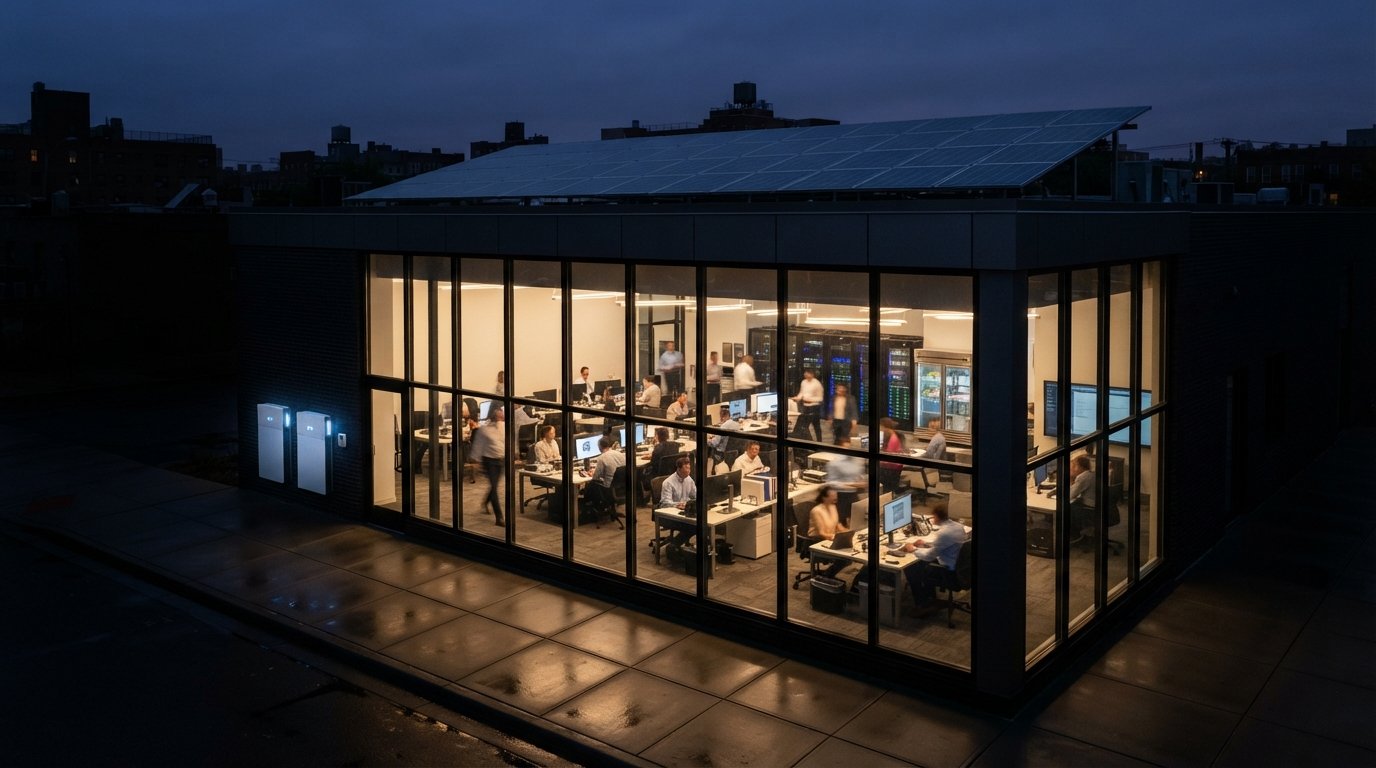
Emergency Solar Power Solutions for Businesses in 2026
Emergency solar power solutions for businesses keep critical loads running during outages while cutting demand charges and energy costs all year.

By Dylan Harris
Learn more about Solar Panel Installation and Repair for guides, costs, and what to expect.
Compare Solar Panel Installation and Repair Pros Near You

Enter your ZIP code to compare top-rated local professionals and request free quotes.
When the grid goes down, every minute of downtime costs your business money, customers, and reputation. A single extended outage can halt production lines, spoil inventory, freeze transaction systems, and send employees home without pay. For a growing number of U.S. companies, the answer is not a louder diesel generator but a smarter solar-plus-storage system that keeps critical loads running quietly, cleanly, and automatically. Emergency solar power solutions for businesses have moved from niche backup to mainstream resilience strategy, and 2026 is shaping up as the year when commercial adoption accelerates fastest.
Why Commercial Outages Are Getting Worse
Utility reliability data tells a consistent story: major outage events in the United States have climbed in frequency and duration over the past decade. Extreme heat, wildfire risk, hurricanes, ice storms, and an aging transmission network all contribute. For businesses, the math is unforgiving. A retail location that loses refrigeration for six hours may discard thousands of dollars in perishable goods. A manufacturing plant that loses power mid-process may scrap an entire production batch and face restart costs that dwarf the original electricity bill.
Traditional backup has been diesel or gas generators, but those come with their own liabilities. Fuel may be unavailable during regional emergencies, generators need regular testing and maintenance, exhaust permits can be restrictive in urban areas, and fuel storage raises environmental and insurance concerns. Solar with battery storage avoids most of these problems because the fuel, sunlight, arrives free every day and the system can operate silently with no combustion.
There is also a financial angle that more CFOs are noticing. Solar-plus-storage systems do double duty: they generate savings during normal operation through demand charge management, time-of-use arbitrage, and net metering, then they deliver resilience during outages. That dual value stream shortens payback periods and makes the resilience investment easier to justify to ownership or a board.
What an Emergency Solar Solution Actually Includes
An emergency solar power solution for a business is not simply rooftop panels. It is an integrated system designed around which loads must stay energized, for how long, and under what conditions. The core components typically include solar arrays, a battery energy storage system, a hybrid inverter or power conversion system, automatic transfer equipment, and a monitoring platform that can alert facilities staff the moment grid power drops.
The design process starts with a critical load audit. Facilities managers identify which circuits must remain live: life safety systems, security cameras, servers, point-of-sale terminals, refrigeration, medical equipment, or specific production machinery. Everything else can be shed during an outage to extend runtime. This prioritization is what separates a professional commercial installation from a generic residential kit.
Battery chemistry matters too. Lithium iron phosphate (LFP) batteries have become the default for commercial backup because they offer long cycle life, strong thermal stability, and competitive pricing. Some facilities pair a smaller daily-cycle battery with a larger reserve battery dedicated purely to outage coverage, keeping the two functions from competing for the same stored energy.
Businesses that want a hands-on walkthrough of the design and procurement process can contact our solar power solutions team for guidance on sizing, incentives, and installation partners.
Key Benefits Beyond Simple Backup
Resilience is the headline benefit, but it is not the only one. Commercial solar-plus-storage systems produce measurable returns year-round, even when no outage ever occurs. Understanding those stacked benefits helps decision-makers compare solar against a generator on total cost of ownership rather than sticker price alone.
- Demand charge reduction: Batteries can shave peak demand spikes that utilities bill at premium rates, often the single largest line item on a commercial electric bill.
- Time-of-use arbitrage: Stored solar energy can be discharged during expensive evening peak windows instead of buying from the grid.
- Tax incentives: The federal investment tax credit and accelerated depreciation can cover a substantial share of system cost, and additional state or utility rebates often apply.
- Brand and ESG value: Clean backup power supports sustainability reporting and can be a differentiator with customers and investors.
- Operational continuity: Automatic switchover means employees and systems keep working without manual intervention or fuel logistics.
That last point deserves emphasis. During a regional crisis, diesel suppliers get overwhelmed, roads close, and refueling becomes a logistical project. A solar-plus-storage system simply continues operating from stored energy and daytime production. For hospitals, data centers, cold storage warehouses, and communications sites, that reliability difference can be decisive.
How to Size a System for Real Outage Scenarios
Sizing starts with three questions: what loads must run, how much power do they draw, and how long must they run without sun? A facility that only needs to ride through a four-hour evening outage has very different requirements from one that must operate autonomously for three days during a wildfire shutoff. The National Renewable Energy Laboratory and DOE resilience tools can help model these scenarios, but a qualified installer will translate the numbers into equipment.
The process usually follows a predictable sequence. First, conduct a load audit and categorize circuits by priority. Second, model outage durations based on local utility history and climate risk. Third, size the battery for the longest realistic scenario, then size the solar array to recharge that battery within a normal solar day. Fourth, confirm interconnection rules with the utility, since some jurisdictions limit how backup systems may operate during grid outages. Fifth, build in monitoring and annual testing so the system is verified ready when it is actually needed.
One common mistake is oversizing solar without matching storage. A large array is useless at night or under heavy cloud if the battery cannot hold enough energy. Conversely, an oversized battery without adequate solar charging will not sustain a multi-day event. Balance is the goal, and it is where experienced commercial designers add the most value.
Costs, Incentives, and Payback Realities
Commercial solar-plus-storage pricing varies widely by region, system size, and whether the installation involves roof mounting, ground mount, or carport structures. As a rough planning range, many small and mid-sized commercial systems land between $2.50 and $4.00 per watt before incentives, with storage adding a separate per-kilowatt-hour cost. Larger projects benefit from economies of scale, and the federal investment tax credit plus bonus depreciation can materially reduce net cost.
Payback is rarely driven by outage avoidance alone, because outages are unpredictable. Instead, the financial case combines energy savings, demand charge reduction, incentive value, and a resilience premium that many insurers and lenders now recognize. Some commercial property insurers offer premium credits for facilities with on-site clean backup power, and some utilities provide resilience-focused rebates for storage in wildfire or hurricane zones.
Financing options have also matured. Power purchase agreements, solar leases, property assessed clean energy (PACE) financing, and equipment loans let businesses install systems with minimal upfront capital. For companies that want current market pricing and a side-by-side view of financing options, independent resources such as NewSolarQuotes provide educational guides and cost calculators that complement a formal installer quote. Always verify current incentive amounts with a tax professional and your utility, since programs change annually.
Choosing the Right Installation Partner
The quality of the installation partner often matters more than the brand of panels or batteries. A commercial emergency solar system involves electrical work, structural assessment, utility coordination, permitting, and ongoing service. A partner with commercial experience will anticipate these details; a residential-focused installer may not.
When evaluating proposals, ask specific questions. How many comparable commercial systems has the installer commissioned? What is the warranty on labor as well as equipment? How will the system be monitored and serviced, and what is the response time for a fault? Does the proposal include a critical load audit and a written outage runtime estimate? A strong proposal answers all of these without prompting.
It also helps to check whether the installer offers complementary services. Energy audits, emergency lighting, and electrical security upgrades often pair naturally with a solar-plus-storage project and can be bundled to reduce mobilization costs. A single trusted provider for these related systems simplifies maintenance and accountability.
Common Mistakes That Undermine Emergency Readiness
Even well-intentioned projects can fall short if planning skips key steps. One frequent error is failing to test the system under real outage conditions. A battery that has never been discharged under load may reveal capacity or configuration problems only when it matters most. Scheduled annual blackout drills, coordinated with the installer, catch these issues early.
Another mistake is ignoring cybersecurity. Modern inverters and monitoring platforms connect to the internet, and unpatched firmware can expose operational technology to risk. Choose equipment with strong security track records, segment the system on a separate network, and keep firmware current. For businesses with regulated data, involve IT and compliance teams from the start.
Finally, do not treat the system as a one-time purchase. Batteries degrade, software evolves, and utility programs change. A maintenance contract that includes remote monitoring, periodic capacity testing, and firmware updates protects the investment and keeps the emergency function trustworthy for a decade or more.
Where Emergency Solar Is Heading Next
Technology is making these systems smarter and more affordable every year. AI-driven energy management platforms now forecast load, weather, and tariff conditions, then optimize when to charge and discharge for maximum savings and readiness. Vehicle-to-building integration is emerging as another resilience layer, letting electric fleet vehicles double as mobile batteries during outages. Microgrid controllers allow multiple buildings on a campus to share stored energy intelligently rather than each operating in isolation.
Policy is moving in the same direction. Federal incentives continue to favor storage, and a growing number of states require utilities to consider resilience value when evaluating distributed energy resources. For businesses, that means the financial and operational case for solar-plus-storage backup will only strengthen through the decade.
Emergency solar power solutions for businesses are no longer a contingency for the largest enterprises. They are becoming a practical, financeable standard for small and mid-sized operations that cannot afford to sit dark while competitors keep running. The businesses that act early will lock in better incentives, gain a resilience advantage, and turn an operational risk into a long-term asset.