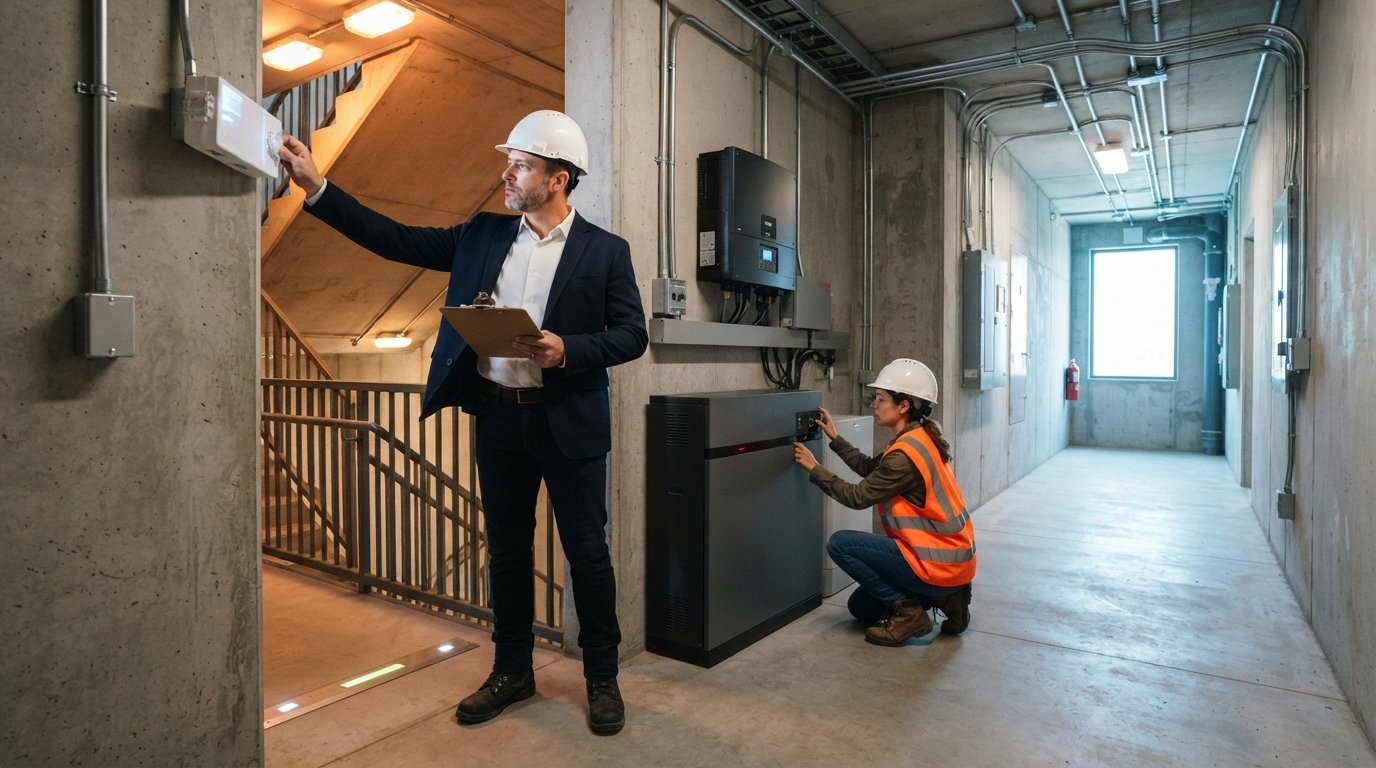
Commercial Solar Emergency Power Plan With Backup Lighting
Build a commercial solar emergency power plan with backup lighting that protects revenue and meets code. Call 8334344023 to get started.

By Isaac Reed
Learn more about Solar Panel Installation and Repair for guides, costs, and what to expect.
Compare Solar Panel Installation and Repair Pros Near You

Enter your ZIP code to compare top-rated local professionals and request free quotes.
When the grid goes down, a commercial building does not simply go dark. It goes dangerous. Stairwells become hazards, exit routes disappear, security systems lose their watch, and tenants or employees start asking hard questions about liability. For facility managers and business owners, the real question is not whether an outage will happen, but whether the building will be ready when it does. A commercial solar emergency power plan with backup lighting turns that vulnerability into a controlled, code-compliant, and often revenue-protecting advantage. Building one requires more than buying a battery and a few fixtures. It means mapping critical loads, sizing storage against real outage data, choosing lighting that satisfies life-safety codes, and integrating everything with the solar array already on the roof or planned for it.
The stakes are higher than most people assume. The National Fire Protection Association and local building codes require emergency illumination in specific paths of egress, and OSHA expects workplaces to have reliable emergency lighting where power loss could create hazards. Meanwhile, insurance carriers increasingly view robust backup power as a risk-reduction feature that can influence premiums. A solar-plus-storage emergency plan addresses all of these pressures at once, because the same battery that keeps the lights on during an outage also shaves peak demand charges and stores cheap midday solar production for evening use. The plan is the difference between an expensive battery sitting idle and an asset that earns its keep every single day.
Why Commercial Buildings Need a Solar Emergency Power Plan
Traditional emergency lighting relies on small internal batteries inside each fixture, typically good for 90 minutes of run time. That standard was written for brief outages and quick evacuations, not for the multi-hour or multi-day disruptions that extreme weather, wildfire prevention shutoffs, and grid instability now produce. A commercial solar emergency power plan with backup lighting replaces that patchwork with a centralized, solar-charged reserve that can power egress lighting, security cameras, refrigeration, IT closets, and other critical loads for far longer than a wall-mounted unit can manage.
The financial case is equally compelling. According to the U.S. Department of Energy, outages cost commercial and industrial customers billions of dollars annually, with losses concentrated in sectors like retail, food service, manufacturing, and data operations. A single afternoon of downtime can wipe out a month of energy savings from a solar array. By pairing solar generation with battery storage and a defined emergency lighting strategy, a business converts its solar investment into a resilience asset rather than just a bill-reduction tool. For companies that also want to understand how to structure that investment, our guide on commercial solar lease vs purchase explains how financing choices affect ownership of the backup equipment and the long-term economics of resilience.
There is also a compliance dimension that many facility teams underestimate. Emergency lighting must be tested and documented, and a centralized solar-backed system simplifies that process because the battery state of charge, inverter status, and lighting circuits can all be monitored from a single dashboard. Instead of chasing dozens of individual fixture batteries, a facility manager can pull one report that shows whether the system is ready for an inspection or a real event. That operational clarity is often the hidden benefit that convinces leadership to approve the project.
Core Components of a Solar Emergency Power Plan
Every effective plan rests on four building blocks: generation, storage, transfer, and load management. Solar panels generate electricity during the day, a battery bank stores it, an automatic transfer switch or gateway isolates the building from the grid when it fails, and a prioritized load panel decides what gets powered first. Backup lighting sits at the top of that priority list because it is a life-safety function, but it should not be the only load. Security systems, fire alarm panels, network equipment, and sump pumps are common additions that justify the cost of a larger battery.
Sizing is where most DIY approaches fail. A facility needs to know its critical load in kilowatts, the expected duration of an outage in hours, and the solar production available during the outage window. A building in Phoenix with strong winter sun will size differently from a facility in the Pacific Northwest, even if their loads are identical. The calculation should also account for battery depth of discharge, inverter efficiency, and a safety margin for aging equipment. Getting this wrong means either overspending on capacity or discovering during a real event that the battery drains faster than expected.
Backup lighting itself comes in several forms, and the right mix depends on the building type. The most common options include:
- Central inverter emergency lighting: standard fixtures wired to a dedicated emergency circuit powered by the battery, ideal for offices and retail.
- Self-contained LED units: fixtures with internal batteries for localized coverage, useful in stairwells and restrooms.
- High-bay emergency luminaires: designed for warehouses and industrial spaces with tall ceilings.
- Exterior egress and parking lighting: solar-backed pole lights that keep parking lots and walkways safe during regional outages.
- Combination exit signs and illumination: code-required signage with integrated emergency power.
Choosing among these options is not just a technical decision; it is a code decision. Local authorities having jurisdiction will expect emergency illumination in exit access corridors, exit discharge paths, and areas with high occupant load. A qualified solar and electrical contractor can map those zones and specify fixtures that meet both illumination levels and run-time requirements. Facilities that want a single provider for assessment, installation, and ongoing monitoring can explore the independent solar education and quote platform at NewSolarQuotes, which helps businesses compare vetted installers and understand how backup power fits into a broader renewable energy strategy.
Designing the Plan: A Step-by-Step Framework
A commercial solar emergency power plan should be documented, not improvised. The design process moves from risk assessment to load analysis to equipment specification, and each step informs the next. The goal is a written plan that a facility manager can hand to an electrician, an inspector, or an insurance adjuster and have it make immediate sense.
The sequence below reflects how experienced commercial solar teams approach the work. Following it reduces the chance of costly rework and ensures that the backup lighting system integrates cleanly with the existing or planned solar array.
- Conduct an outage risk assessment: review utility reliability data, weather patterns, and local grid vulnerabilities to estimate how often and how long outages are likely to last.
- Identify and prioritize critical loads: list every circuit that must stay energized, starting with life-safety lighting, then security, communications, and temperature-sensitive equipment.
- Size the solar and storage system: calculate array capacity and battery kilowatt-hours needed to carry those loads through the target outage duration.
- Select backup lighting fixtures and controls: specify fixtures that meet code, integrate with the emergency panel, and can be monitored remotely.
- Document testing and maintenance procedures: establish monthly, annual, and post-event inspection routines that satisfy code and keep the system reliable.
Step two deserves extra attention because it is where budgets are won or lost. A common mistake is to designate every load as critical, which drives up battery cost without adding real resilience. A better approach is to rank loads in tiers: tier one for life-safety lighting and fire systems, tier two for security and IT, tier three for comfort and convenience. The battery is sized to tier one and tier two, with tier three powered only if capacity allows. This tiered design keeps the project financially realistic while still protecting what matters most.
Documentation should also cover the human side of an outage. Who is responsible for verifying that the transfer switch operated correctly? Who monitors battery state of charge during an extended event? Who communicates with tenants or employees? A plan that exists only in an engineering folder will not perform when it is needed. Simple, written procedures and a designated point person turn a technical installation into an operational capability.
Integrating Backup Lighting With Solar and Storage
The magic of a solar emergency power plan is that the same infrastructure serves two masters. During normal operation, the battery performs peak shaving and stores excess solar production for evening use, reducing demand charges and improving return on investment. During an outage, it seamlessly switches to backup mode and powers the emergency lighting and other critical circuits. This dual-purpose design is what makes the economics work, because the battery is not a standby cost center; it is a working asset every day.
Integration details matter. The inverter must be capable of grid-forming operation so it can establish a stable voltage and frequency reference when the grid is absent. The transfer equipment must isolate the building from the utility to protect line workers and prevent backfeed. The emergency lighting circuits must be clearly labeled and separated from non-critical circuits so that a future electrician does not accidentally move a fixture onto the wrong panel. Monitoring software should display battery state of charge, solar production, and emergency circuit status in one view, ideally with alerts when something falls out of specification.
Modern systems also support intelligent load shedding. If an outage stretches into a second day and the battery is draining faster than solar can replenish it, the system can automatically drop tier-three loads to preserve tier-one lighting. This kind of automation is especially valuable for buildings that are unoccupied overnight or on weekends, when no one is present to make manual adjustments. The result is a system that protects life-safety functions even under prolonged stress.
For businesses that want to go further, pairing backup lighting with an on-site energy audit can reveal other resilience opportunities. An audit might show that a refrigeration circuit could be shifted to the emergency panel for modest cost, or that LED retrofits would reduce the load the battery must carry. These small adjustments compound, extending run time without adding battery capacity. Facilities that treat the emergency plan as part of a continuous improvement process get far more value than those that install equipment and walk away.
Costs, Incentives, and Return on Investment
A commercial solar emergency power plan with backup lighting is a capital project, and leadership will want to see the numbers. Costs vary widely based on building size, battery capacity, lighting fixture count, and whether the solar array already exists. A small retail building might need a modest battery and a dozen emergency fixtures, while a warehouse or data center could require a much larger storage system and sophisticated load management. Installation labor, permitting, and inspection add to the total, and those soft costs can be significant in markets with complex permitting processes.
On the incentive side, the federal investment tax credit has historically covered a substantial percentage of solar and battery storage costs for commercial projects, and additional depreciation benefits can improve the after-tax return. State and utility programs may add rebates or performance payments, particularly for storage that supports grid reliability. Because incentive rules change, every project should verify current eligibility with a qualified tax advisor and the relevant program administrator before finalizing the budget.
The return on investment comes from several streams. Energy savings from solar generation and peak shaving reduce operating costs every month. Outage avoidance protects revenue that would otherwise be lost during downtime. Insurance premium reductions may apply where the carrier recognizes the backup system as a risk mitigation feature. In some markets, the battery can participate in demand response programs and earn additional revenue. When these streams are added together, the payback period for a well-designed system can be substantially shorter than the sticker price suggests.
It also helps to compare the cost of the system against the cost of doing nothing. A single extended outage can cost a grocery store its entire perishable inventory, a manufacturer its production schedule, and a professional services firm its client trust. When those potential losses are quantified, the emergency power plan often looks less like an expense and more like insurance with a positive return. Framing the project that way helps decision-makers see the strategic value rather than just the capital outlay.
Maintenance, Testing, and Code Compliance
Emergency lighting systems are only as good as their maintenance. Codes typically require monthly functional tests and annual duration tests, with written records kept for inspection. A solar-backed system can automate much of this work through self-testing fixtures and monitoring software, but human verification still matters. Batteries degrade, connections loosen, and fixtures fail. A maintenance schedule that catches these issues early prevents the unpleasant discovery that the system does not work when it is needed most.
Compliance also extends to labeling and documentation. Emergency circuits must be clearly marked, transfer switches must be identified, and as-built drawings should reflect the actual installation. When a new tenant moves in or a renovation occurs, those records prevent accidental disconnection of critical circuits. Facilities that maintain clean documentation pass inspections more easily and avoid the fines and liability that come with non-compliant life-safety systems.
Finally, it is worth reviewing the plan annually. Building use changes, codes evolve, and battery performance shifts over time. An annual review keeps the plan aligned with reality and identifies opportunities to expand coverage or reduce costs. Businesses that treat emergency power as a living system rather than a one-time installation are the ones that stay resilient through every outage season.
A commercial solar emergency power plan with backup lighting is ultimately a statement about how a business values its people, its property, and its continuity. It combines renewable generation, intelligent storage, and code-compliant illumination into a single strategy that pays for itself in savings and peace of mind. Whether the goal is protecting a retail floor, a warehouse operation, or a professional office, the right plan starts with a clear assessment of risk and a commitment to doing the work properly. With the right partners and a documented approach, any commercial building can turn its solar investment into a dependable source of light when the grid goes dark.