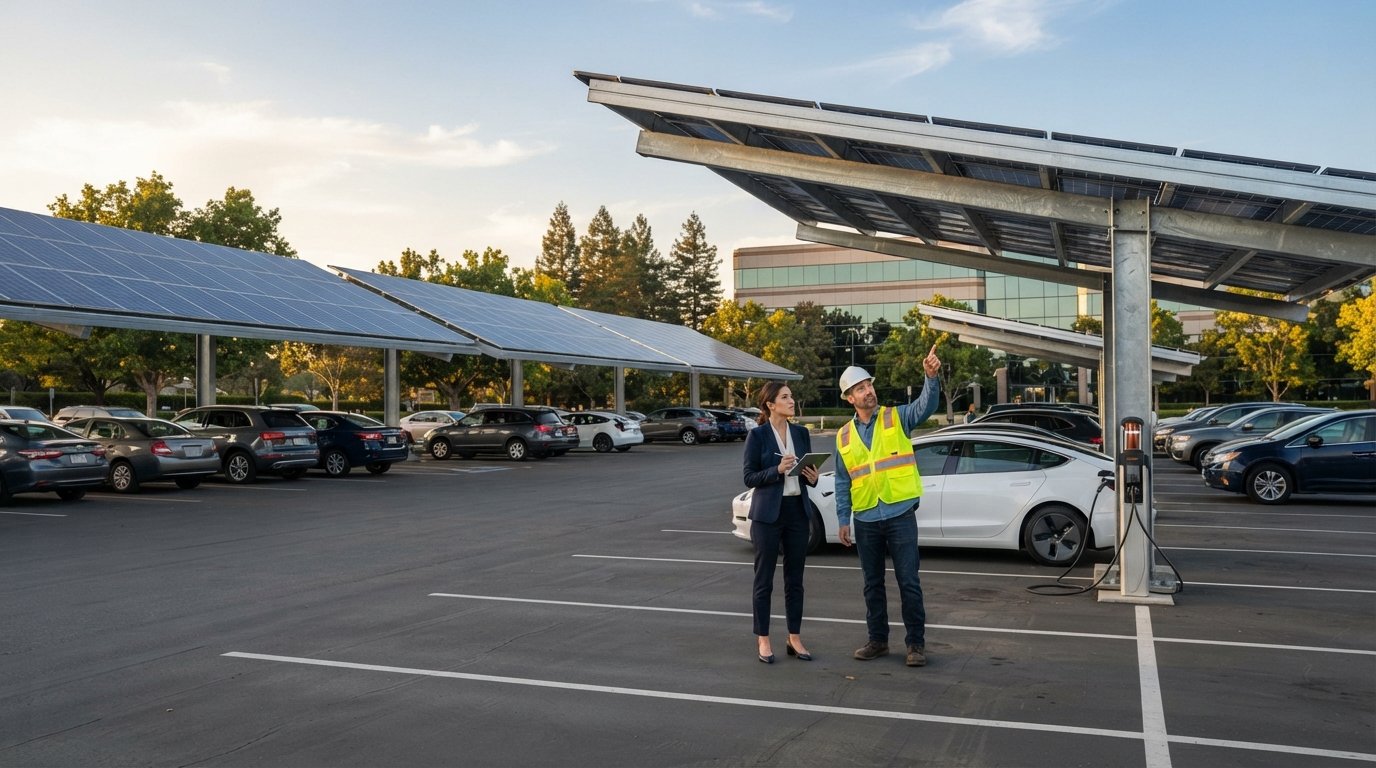
Commercial Solar Carport Financing and Tax Treatment
Master commercial solar carport financing and tax treatment to maximize ROI. Call (833)-434-4023 for expert guidance.

By Adam Adler
Learn more about Solar Panel Installation and Repair for guides, costs, and what to expect.
Compare Solar Panel Installation and Repair Pros Near You

Enter your ZIP code to compare top-rated local professionals and request free quotes.
Commercial solar carports turn underused parking lots into revenue-generating, shaded assets while cutting operating costs and strengthening sustainability credentials. Yet the financial upside hinges on two intertwined questions: how you pay for the structure and how the tax code treats it. Get those right, and a carport can outperform a rooftop array on total return. Get them wrong, and you may leave depreciation benefits, tax credits, or cash flow advantages on the table. This guide walks through the cost dynamics, tax rules, financing routes, and site requirements that shape a successful commercial solar carport project.
Why Carports Cost More Than Rooftop Solar (and Why They Can Still Win)
A solar carport is a dual-purpose asset: it generates electricity and provides covered parking. That dual role adds structural steel, foundations, drainage, lighting, and often EV charging infrastructure, pushing installed costs above a comparable rooftop system. On a per-watt basis, carports can run 20 to 40 percent higher than rooftop arrays, depending on span, wind load, snow load, and local permitting. The structure itself, not the panels, drives much of the premium.
But cost is only half the story. Carports unlock parking lot space that would otherwise sit idle, create new revenue streams through shaded parking or EV charging fees, and can be scaled in phases to match capital availability. They also avoid roof warranty complications and structural reinforcement costs that sometimes plague rooftop projects. For businesses with large lots and limited roof space, the carport often delivers a better long-term return despite the higher upfront price.
Understanding the full cost picture starts with separating the solar array from the carport structure. The array (panels, inverters, racking) typically qualifies for the federal investment tax credit (ITC), while the structure may or may not, depending on how it is classified. That classification also drives depreciation. Before you commit, model both the direct costs and the tax treatment of each component.
Tax Treatment: ITC Eligibility and Depreciation for Carport Arrays
The federal solar ITC remains the cornerstone of project economics. For commercial projects, the credit generally equals 30 percent of eligible solar equipment costs, with potential adders for domestic content or energy community siting. The key question for carports is whether the structure itself counts as part of the solar energy property. In many cases, the IRS treats the carport as a building or structural component rather than solar equipment, which means only the array and related electrical balance-of-system costs qualify for the ITC. The structure may instead be depreciated as a separate asset class.
Depreciation rules are equally important. Solar energy property placed in service before 2027 may qualify for 100 percent bonus depreciation under current law, allowing you to deduct the entire eligible basis in the first year. However, bonus depreciation phases down for projects placed in service after 2026 unless Congress extends it, so timing matters. For carport structures that do not qualify as solar property, you may need to use a longer recovery period (often 39 years for nonresidential real property) or qualify for accelerated depreciation if the structure is considered personal property. The distinction between real and personal property can significantly affect after-tax returns.
Because tax rules are complex and subject to change, always verify eligibility with a tax advisor who specializes in renewable energy. The IRS has issued guidance on solar carports, but fact-specific determinations (such as whether the structure is essential to the operation of the solar array) can influence outcomes. Documenting the intended use and consulting a professional early in the design phase can prevent costly surprises.
Financing Routes: Loans, PPAs, Leases, and Property-Assessed Options
Commercial solar carport financing typically follows one of four paths: direct ownership with a loan, a power purchase agreement (PPA), a lease, or property-assessed clean energy (PACE) financing. Each has distinct tax and cash flow implications. Choosing the right one depends on your tax appetite, available capital, and long-term energy goals.
Direct ownership with a loan maximizes tax benefits because you own the asset and can claim the ITC and depreciation. If your business has sufficient tax liability, this route often produces the highest lifetime savings. However, it requires upfront capital or debt service capacity. PPAs and leases shift ownership to a third party, who claims the tax benefits and sells you the electricity or leases the system at a predictable rate. These structures reduce upfront costs and transfer performance risk, but you forgo the tax incentives. PACE financing allows you to repay costs through a property tax assessment, which can be attractive for longer-term holds but may complicate property sales.
When comparing financing options, consider these key factors:
- Tax appetite: Can you use the ITC and depreciation in the year generated? If not, a PPA or lease may deliver better net savings.
- Cash flow: Loans require debt service; PPAs and leases convert capital expenses into operating expenses.
- Ownership goals: Direct ownership gives you control and residual value; third-party structures simplify operations but limit long-term upside.
- Property considerations: PACE assessments attach to the property and may affect refinancing or sale.
For a deeper comparison of ownership versus third-party financing, see our guide on commercial solar lease vs purchase, which breaks down the trade-offs in detail. Many businesses blend approaches, using a loan for the array and a separate agreement for EV charging infrastructure.
Dual-Use Revenue: EV Charging and Shaded Parking
Carports shine when they do more than generate electricity. Adding EV charging stations under the canopy creates a new revenue stream and attracts tenants or customers who value convenience. Shaded parking itself can command premium rates in hot climates, and some businesses monetize reserved spaces. These dual-use features improve project economics and can shorten payback periods.
From a tax perspective, EV charging equipment may qualify for separate incentives, such as the alternative fuel vehicle refueling property credit (30C), which can be stacked with solar incentives in some cases. However, the interaction between solar and EV credits requires careful planning to avoid double-counting costs. The structure may also need to be sized for future charging loads, so design flexibility is valuable.
Operationally, dual-use carports require robust monitoring and maintenance. Solar panels must be kept clean, and EV chargers need periodic servicing. Many businesses bundle these services into a single O&M contract to simplify management. The added revenue and customer amenity often justify the complexity.
Site and Structural Requirements That Affect Feasibility
Not every parking lot is carport-ready. Structural requirements vary by region and can significantly impact cost. Key considerations include:
- Wind and snow loads: Local building codes dictate the structural steel and foundation design, which can add cost in high-load areas.
- Soil conditions: Poor soils may require deeper foundations or pile systems, increasing civil work.
- Drainage: Carports alter stormwater flow, so you may need retention or drainage upgrades to comply with local regulations.
- Clearance and layout: Adequate drive aisles and parking stall dimensions must be maintained; fire access lanes cannot be obstructed.
- Electrical infrastructure: Distance to the interconnection point affects wiring costs; upgrades to switchgear or transformers may be needed.
Engaging a structural engineer and a solar contractor early helps identify constraints before design is finalized. Permitting timelines also vary widely; some jurisdictions have streamlined solar carport approvals, while others require extensive review. Budgeting time and contingency for permitting is essential.
For businesses planning broader facility upgrades alongside solar, resources like PlanRemodel can help identify qualified contractors for related work, from roofing to electrical. Coordinating solar carport installation with other improvements can reduce mobilization costs and downtime.
Putting It Together: A Decision Framework
To evaluate a commercial solar carport project, start with a feasibility study that models energy production, construction costs, and available incentives. Then compare financing options side by side, paying close attention to tax treatment. A simple framework can guide the decision:
- Assess site and structural feasibility: Confirm load capacities, drainage, and electrical interconnection.
- Model costs and incentives: Separate solar and structure costs; determine ITC eligibility and depreciation schedule.
- Compare financing routes: Run cash flow projections for loan, PPA, lease, and PACE scenarios.
- Quantify dual-use revenue: Include EV charging and shaded parking income where applicable.
- Consult tax and legal advisors: Validate assumptions and structure the deal to maximize after-tax returns.
Each step informs the next, and iteration is common. Sensitivity analysis on key variables (electricity rates, tax credits, construction costs) helps you understand risk. Many businesses find that a phased approach, starting with a smaller carport and expanding as cash flow allows, balances risk and reward.
Finally, consider ongoing operations and maintenance. Solar carports require periodic cleaning, inverter maintenance, and structural inspections. Budgeting for O&M ensures long-term performance and protects your investment. With proper planning, a commercial solar carport can deliver decades of clean energy, reduced operating costs, and enhanced property value.
To connect with vetted solar professionals and explore financing options tailored to your project, reach out to our team at (833)-434-4023 or visit SolarEnergy.ai for tools and guides. Every project is unique, so verify tax and incentive details with qualified advisors before proceeding.