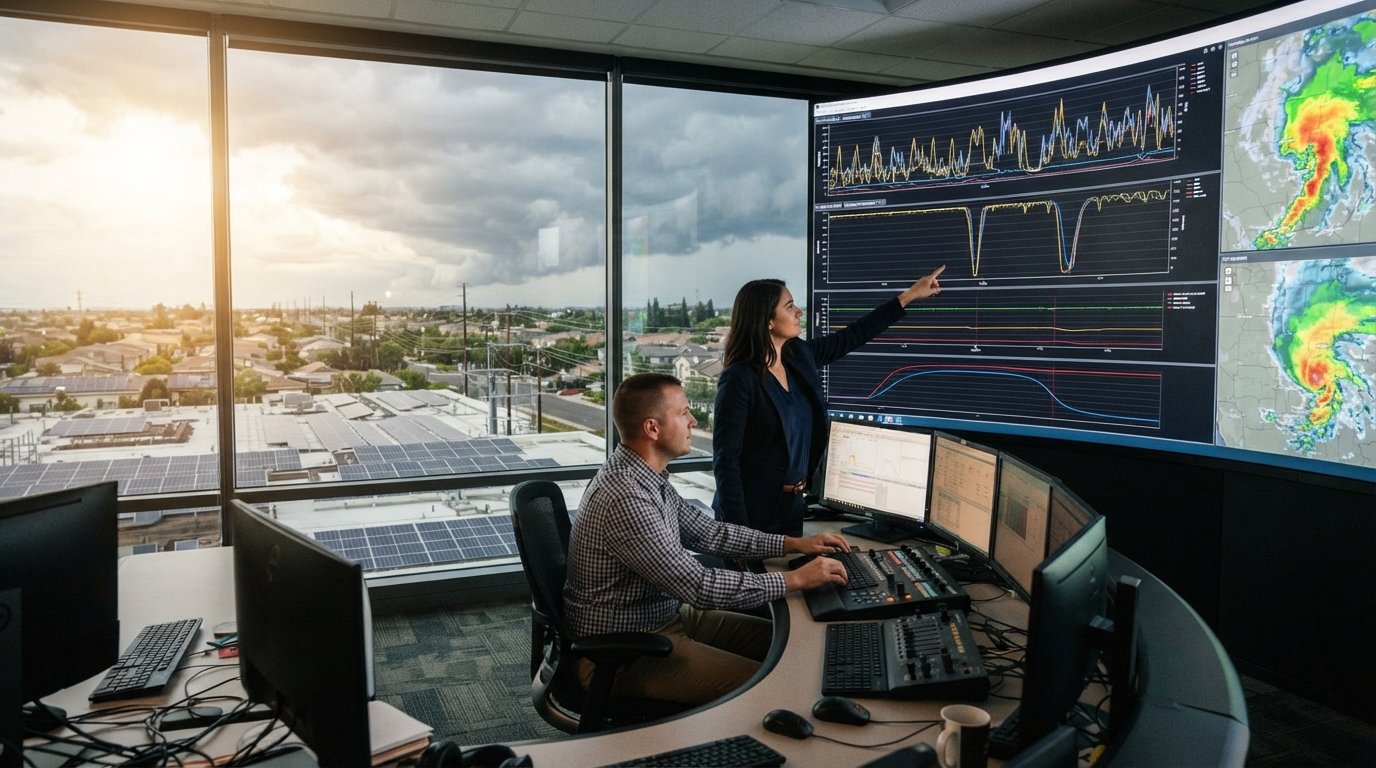
AI Solar Forecasting for Grid Resilience and Stability
AI solar forecasting keeps the grid stable as solar adoption grows. Call (833)-434-4023 to explore smarter solar and storage options for your home.

By Isaac Reed
Learn more about Solar Panel Installation and Repair for guides, costs, and what to expect.
Compare Solar Panel Installation and Repair Pros Near You

Enter your ZIP code to compare top-rated local professionals and request free quotes.
Every time a cloud passes over a neighborhood, solar output on that feeder can drop by 60 to 80 percent in under a minute. Multiply that by thousands of rooftops and you get the central challenge of the modern grid: solar power is clean, cheap, and stubbornly unpredictable. AI solar forecasting for grid resilience and stability is the technology now being deployed to solve that problem, and it is changing how utilities, homeowners, and installers think about the sun as a power source.
For decades, grid operators balanced supply and demand by dialing power plants up or down. Solar inverters do not take orders that way. They produce whatever the weather allows, which means the grid must absorb sudden swings in generation while keeping voltage and frequency inside narrow limits. Artificial intelligence closes that gap by predicting solar output minutes, hours, and days ahead, giving operators time to react instead of scramble.
Why Solar Variability Threatens Grid Stability
The electric grid operates on a simple principle: generation must match demand at every instant. Traditional power plants provide what engineers call inertia, a physical resistance to sudden change that buys operators precious seconds to balance the system. Solar photovoltaic systems invert DC power into AC electricity through power electronics, which provide no inertia at all. When solar makes up a small share of the mix, this hardly matters. When it climbs past 20 or 30 percent of generation on a sunny afternoon, as it now does in California, Hawaii, and parts of Texas, the physics change.
Two problems dominate. The first is ramp rate: solar output can fall from full production to near zero in the 30 to 60 minutes around sunset, forcing operators to bring massive amounts of replacement generation online quickly. The second is volatility: passing clouds create rapid, localized fluctuations that cause voltage swings on distribution circuits, nuisance inverter trips, and stress on transformer tap changers. Both problems are forecastable, but only with tools that can process weather data, satellite imagery, and historical production at a scale no human analyst can match.
The stakes extend beyond equipment wear. Reliability regulators in several states now require utilities to demonstrate they can manage solar variability before approving new interconnection requests. Without accurate forecasting, utilities respond by limiting how much solar can connect to a feeder, which slows adoption and raises costs for everyone. Forecasting, in other words, is not just an operational nicety. It is the gatekeeper for how much solar a grid can safely accept.
How AI Solar Forecasting Actually Works
Modern solar forecasting combines three data streams: numerical weather prediction models, satellite and sky-imaging observations, and historical production data from the solar assets themselves. Machine learning models, typically deep neural networks and gradient-boosted ensembles, learn the relationship between those inputs and actual power output at a specific site or region. The result is a probabilistic forecast: not just how much power to expect, but the range of likely outcomes and the confidence level attached to each.
Forecast horizons matter as much as accuracy. Grid operators need different tools for different time scales, and a complete forecasting stack typically layers them.
- Nowcasting (0 to 6 hours): uses satellite imagery and ground-based sky cameras to track clouds and predict minute-by-minute output, critical for voltage control and inverter coordination.
- Short-term forecasting (6 to 48 hours): relies on weather models and machine learning to plan unit commitment, reserve levels, and battery charging schedules.
- Medium-term forecasting (3 to 14 days): supports maintenance scheduling, outage planning, and energy market bidding.
- Long-term forecasting (months to years): informs resource planning, interconnection studies, and investment decisions.
Each layer feeds the next. A nowcast that flags a fast-moving cloud front can trigger a reserve adjustment that was planned days earlier based on medium-term forecasts. The accuracy gains are substantial: leading systems now achieve root-mean-square errors below 10 percent for day-ahead forecasts at aggregated regional levels, compared with 20 to 30 percent for older statistical methods. Those improvements translate directly into fewer ancillary service purchases, less curtailment, and more solar energy actually delivered to customers.
Machine learning also handles the hard cases that trip up conventional models. Snow cover on panels, wildfire smoke, dust storms, and unusual haze events all distort production in ways that physics-based models miss. By training on years of production data paired with weather observations, AI systems learn site-specific quirks, such as a rooftop array that loses 15 percent of output every afternoon when a nearby building casts a shadow. That granularity is where forecasting becomes genuinely valuable.
From Forecasts to Grid Actions: Resilience in Practice
A forecast only creates value when it changes an operational decision. On the transmission side, operators use solar forecasts to schedule reserve capacity more precisely, reducing the number of gas peaker plants idling just in case. On the distribution side, utilities use forecasts to manage voltage regulators, capacitor banks, and smart inverters proactively rather than reactively. In markets with energy storage, forecasts determine when batteries charge from excess solar and when they discharge to cover shortfalls.
Resilience benefits appear most clearly during extreme events. During heat waves, when air conditioning demand peaks just as solar output begins to fade, accurate forecasts let operators pre-position reserves and avoid rolling blackouts. During storms, nowcasting helps utilities anticipate rapid output collapses and island critical facilities on microgrids before the main grid destabilizes. After a wildfire or hurricane, forecasting models can be retrained on damaged infrastructure to support recovery, helping operators bring solar back online safely as crews restore circuits.
Homeowners benefit from the same technology at a smaller scale. Residential energy management systems increasingly use solar forecasts to decide when to run appliances, charge an electric vehicle, or draw from a home battery. In our guide on AI solar forecasting to unlock bigger home energy savings, we explain how these systems shift load to sunny hours and cut reliance on evening grid power. When millions of homes do this together, the aggregate effect smooths the demand curve and reduces the evening ramp that stresses the grid most.
Virtual power plants take the concept further. By aggregating thousands of home batteries, smart thermostats, and flexible loads under a single forecasting and dispatch platform, utilities can call on distributed resources the way they once called on power plants. Forecasting is the brain of that operation: without knowing when solar will produce and when homes will need power, the aggregation cannot be dispatched reliably. Done well, virtual power plants turn a liability (unpredictable rooftop solar) into an asset (fast, flexible grid support).
Benefits Beyond Stability: Economics and Emissions
Forecasting pays for itself in several ways, and the economics are becoming hard to ignore. Better forecasts reduce the need for spinning reserves, the idle generation capacity kept ready to cover unexpected swings. They cut curtailment, the practice of deliberately switching off solar farms when the grid cannot absorb their output. They also improve market outcomes, letting solar operators bid more accurately into day-ahead and real-time markets and avoid penalties for deviation from scheduled production.
Studies of utility-scale deployments consistently find that improving day-ahead forecast accuracy by a few percentage points saves millions of dollars annually across a large balancing area. For homeowners, the savings show up as better battery utilization, fewer peak-rate purchases, and longer equipment life thanks to gentler charge and discharge cycles. There is also a resilience dividend that is harder to quantify but no less real: fewer outages, faster recovery, and less need for utilities to restrict new solar connections.
Emissions fall as a side effect. When operators trust solar forecasts, they can retire or avoid firing the least efficient peaker plants, which are typically the dirtiest and most expensive generators on the system. Every megawatt-hour of solar that is predicted accurately and used rather than curtailed displaces fossil generation. Forecasting does not generate clean power itself, but it determines how much of the clean power we already have actually reaches the grid.
Challenges, Limits, and What Comes Next
AI forecasting is not a solved problem. Data quality remains the biggest obstacle: many distribution circuits lack the sensors needed to measure actual solar output, and utilities often have limited visibility into behind-the-meter systems. Privacy concerns complicate the collection of residential production data, even though aggregated data is what makes forecasts accurate. Model interpretability is another hurdle, since operators are understandably reluctant to act on predictions they cannot explain, especially when those predictions trigger expensive or disruptive decisions.
Regulatory frameworks are still catching up. Some jurisdictions require utilities to use best-in-class forecasting, while others leave it to market participants. Standardizing forecast verification metrics, data-sharing protocols, and cybersecurity requirements for forecasting platforms will be essential as the technology scales. So will workforce training, since control room operators need to trust and interpret probabilistic forecasts rather than simple point predictions.
The next wave of development is already visible. Foundation models trained on global weather and energy data promise to generalize across regions with less site-specific training. Coupling solar forecasts with load forecasts and electric vehicle charging predictions will enable fully integrated grid management. And as edge computing improves, forecasts will increasingly run on inverters and home energy systems themselves, enabling millisecond-level responses that no centralized system can match.
For homeowners and businesses planning solar investments, the practical takeaway is that forecasting quality is becoming a differentiator among installers and equipment. Systems paired with smart inverters and battery storage that can respond to forecasts deliver more value than panels alone. If you are weighing an installation, services like an energy audit before you move can reveal how much of your load can shift to sunny hours, which directly affects the payback period.
AI solar forecasting for grid resilience and stability sits at the intersection of meteorology, machine learning, and power engineering, and it is quietly becoming the backbone of the clean energy transition. The sun will always be intermittent. With better predictions, the grid no longer has to be.